




The Sun's Hidden Temper
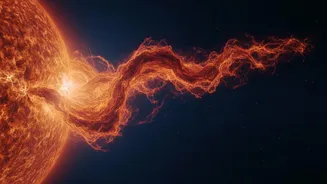
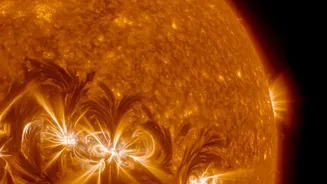
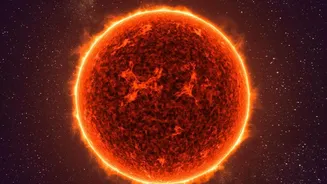
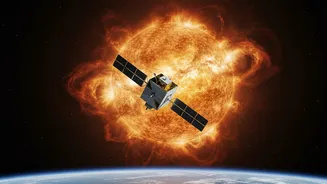
The sun, our life-giving star, has a volatile side. It frequently belches out enormous bubbles of gas and magnetic fields known as Coronal Mass Ejections (CMEs). These are not just gentle puffs; they are explosive events that hurl billions of tonnes of plasma
into space at speeds ranging from a relatively slow 200 km/s to an astonishing 3000 km/s. When this material, threaded with powerful magnetic fields, hurtles towards Earth, it creates what we call space weather. These solar storms can disrupt the constant stream of charged particles flowing from the sun, known as the solar wind, turning it from a steady breeze into a destructive gale.
Satellites in the Firing Line
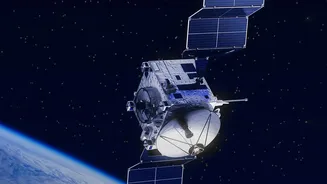
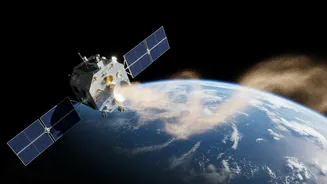
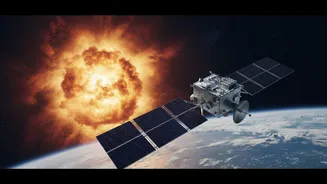
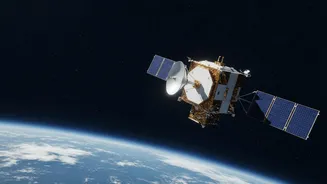
For the thousands of satellites orbiting Earth, a CME is a direct threat. The incoming wave of highly charged particles can cripple a spacecraft in multiple ways. It can cause 'spacecraft charging', where different parts of the satellite build up a high voltage, potentially leading to short circuits and total failure. High-energy particles can also penetrate and degrade sensitive electronics and solar panels. Furthermore, a CME hitting Earth's atmosphere causes it to heat up and expand. This increases atmospheric drag, especially in Low Earth Orbit (LEO), causing satellites to lose altitude faster than expected. In February 2022, a geomagnetic storm caused up to 40 newly launched Starlink satellites to re-enter the atmosphere and burn up because they couldn't overcome the sudden increase in drag.
An Eye on the Storm
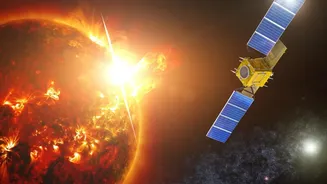
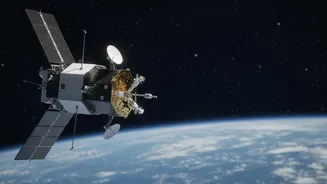
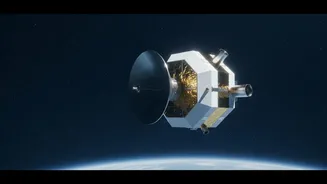
You cannot stop a CME, but you can see one coming. This is where advanced observatories play a critical role. Spacecraft like NASA's Solar and Heliospheric Observatory (SOHO) and India's own Aditya-L1 use instruments called coronagraphs to block out the sun's bright face and watch for eruptions from its outer atmosphere, the corona. Aditya-L1 is strategically positioned at Lagrange Point 1 (L1), about 1.5 million km from Earth, giving it an uninterrupted view of the sun. This vantage point allows it to detect Earth-directed CMEs and provide a crucial early warning, often giving us anywhere from 30 minutes to a few days of notice before impact.
The Science of Prediction
Detecting a CME is only the first step. The real challenge is predicting its path and impact. This is where sophisticated computer modeling comes in. Scientists at agencies like NASA, NOAA, and ISRO feed data on a CME's initial speed, size, and direction into complex models like the Enlil system. These 3D models simulate how the plasma cloud will travel through the heliosphere, accounting for the background solar wind. The goal is to forecast if, when, and how strongly the storm will hit Earth's magnetic field. By combining data from the initial solar observation with real-time measurements from spacecraft like Aditya-L1, which 'tastes' the solar wind conditions, forecasters can refine their predictions and issue timely alerts.
Ducking and Covering in Orbit
Once an alert is issued, satellite operators spring into action. Though they cannot move a satellite out of the way, they can take protective measures. For severe radiation storms, operators may command a satellite to enter 'safe mode'. This involves shutting down non-essential and sensitive electronic systems to prevent them from being fried by charged particles. They can also reorient the spacecraft, turning its solar panels edge-on to the incoming storm to minimise the surface area exposed to damaging radiation and atmospheric drag. For human-crewed missions like those on the International Space Station, astronauts can take shelter in more heavily shielded parts of the station to protect themselves from radiation. These proactive measures, all prompted by predictive models, are essential to preserving the multi-billion dollar infrastructure that powers our modern world.