






A Small Satellite with a Giant Job
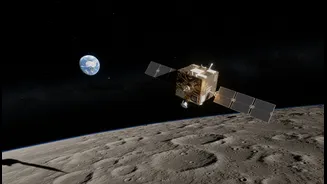
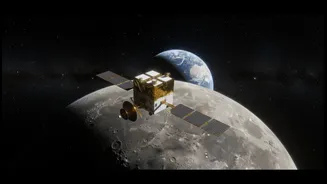
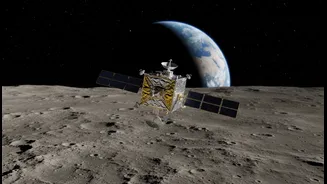
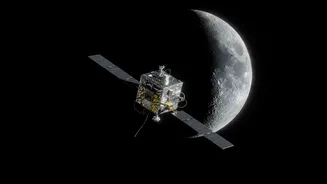
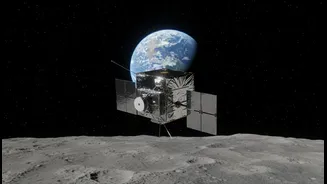
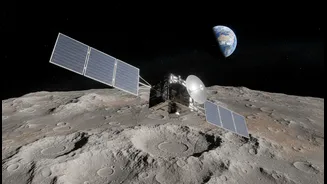
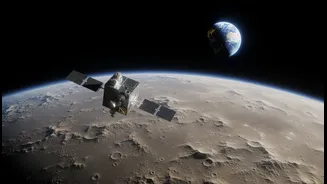
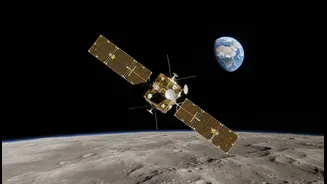
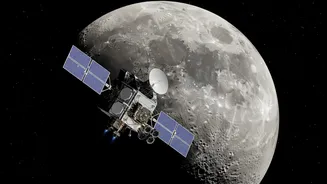
Launched in June 2022, the Cislunar Autonomous Positioning System Technology Operations and Navigation Experiment (CAPSTONE) was never meant to be a flagship mission. Instead, it was a low-cost, 55-pound CubeSat with an outsized responsibility: to act
as a scout for future lunar missions, particularly NASA's Artemis program. Owned and operated by the commercial company Advanced Space, CAPSTONE represents a new, more agile way of doing business in space. Its primary goal was to test a unique and untried path around the Moon, reducing risk for the multi-billion-dollar hardware and human crews set to follow. By succeeding, it established a foundation for commercial support of future lunar operations and expanded opportunities for smaller, more affordable missions.
Conquering a Revolutionary Lunar Orbit
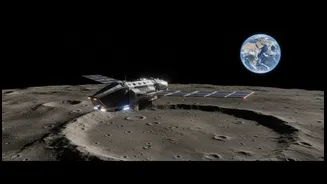
At the heart of CAPSTONE's mission was the near-rectilinear halo orbit (NRHO). Unlike the circular orbits of the Apollo era, the NRHO is a highly elliptical and fuel-efficient path. It uses a precise balance point between the gravity of the Earth and the Moon to offer long-term stability. This special orbit was planned for the Lunar Gateway, a proposed orbiting outpost for astronauts. Before committing a massive station to this path, NASA needed to confirm it was as stable as computer simulations predicted. CAPSTONE became the first spacecraft ever to fly this orbit, successfully inserting itself in November 2022. It proved the trajectory was viable for long-term missions, requiring minimal fuel to maintain.
A 'GPS' for Deep Space
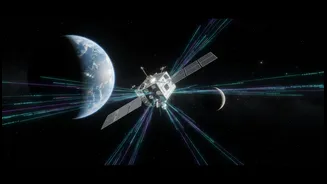
Perhaps the mission's most groundbreaking achievement was its demonstration of autonomous navigation. The Cislunar Autonomous Positioning System (CAPS) software was designed to allow a spacecraft to determine its own location without constantly relying on instructions from Earth. The system was tested through several methods, including by communicating directly with NASA's Lunar Reconnaissance Orbiter (LRO) to perform a celestial version of triangulation. Other tests used onboard cameras to take images of the Earth and Moon to calculate its position. During periods when NASA's Deep Space Network was busy supporting other missions like Artemis II, this autonomous navigation software, called autoNGC, sometimes even outperformed ground-based tracking, proving its immense value for future deep space exploration.
A Flexible, Cost-Effective Testbed
After CAPSTONE completed its primary objectives in May 2023, NASA extended the mission, transforming the small satellite into a flexible, cost-effective lunar technology platform. This allowed NASA to test multiple new technologies without the expense of launching new satellites. During its extended mission, which concluded in June 2026, CAPSTONE tested advanced concepts like delay/disruption tolerant networking (DTN), a type of communication architecture designed for the harsh realities of deep space where signals are often interrupted. By demonstrating that its hardware could host new software applications after launch, CAPSTONE proved the business case for smaller, adaptable missions that can evolve over time.
Paving the Way for Artemis and Beyond
Ultimately, every success of the CAPSTONE mission was a direct step toward enabling a sustained human presence on the Moon. By validating the stability of the NRHO, the mission reduced logistical uncertainties and de-risked the flight path for the future Lunar Gateway. The successful test of autonomous navigation and communication systems means future missions can be less reliant on Earth-based support, making them more efficient and resilient. The data gathered will inform operations planning for NASA's Artemis missions for years to come. Though small in size, CAPSTONE's impact is enormous, providing critical data and proving key technologies that are essential for humanity's next chapter in space exploration.