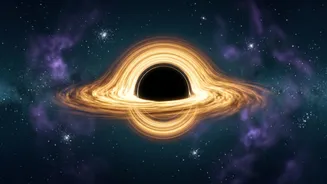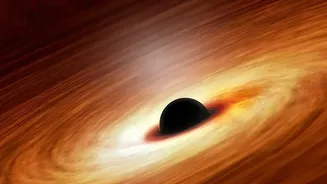




Have you ever looked up at the night sky and dreamt of discovery? Now, you can become a cosmic detective from your own home. A new initiative is calling for volunteers to help find the most mysterious objects in the universe: hidden black holes.
A Galaxy Full of Ghosts
Our Milky
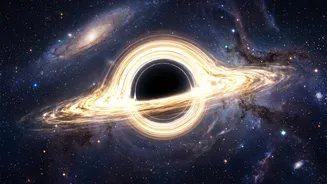
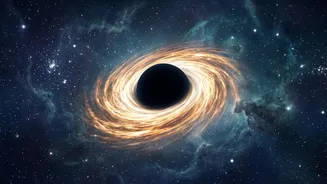
Way galaxy is thought to be home to over 100 million black holes, yet astronomers have only managed to locate about 70 of them. The vast majority are 'hidden' or 'quiet' because they don't have matter falling into them, which would normally release tell-tale X-rays. These invisible giants drift through space, their presence only betrayed by their immense gravity. Finding them is crucial for understanding how massive stars live and die, and how our galaxy has evolved. The Black Hole Hunters project, led by researchers from institutions like the University of Southampton, aims to close this massive gap in our cosmic census by asking for your help.
Your Mission: Spot the Wobble
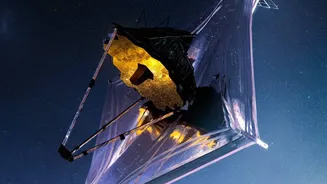
So, how do you find something that is invisible? You look for the effect it has on things you can see. Many of these hidden black holes are in binary systems, orbiting a companion star. As the black hole orbits, its gravity can bend and magnify the light from its companion star when it passes in front, an effect called gravitational self-lensing. This makes the star appear to brighten periodically in a very specific way. Your task as a Black Hole Hunter is to look at graphs of star brightness over time, called light curves, and identify these unique patterns. The data comes from powerful telescopes like NASA’s Transiting Exoplanet Survey Satellite (TESS).
No PhD Required, Just Curious Eyes
You don't need a degree in astrophysics or any prior experience to join the hunt. The project is designed for everyone. In fact, this is a task where the human eye can still outperform computers. While artificial intelligence is used to sift through millions of stars to find potential candidates, it takes a human's superior pattern-recognition ability to distinguish a true black hole signal from other cosmic phenomena that can make a star's brightness vary. The project, hosted on the citizen science platform Zooniverse, provides a simple tutorial showing you exactly what to look for. It’s as simple as spotting a specific shape in a graph.
How to Get Started
Joining the search is straightforward. You can participate from anywhere in the world using a computer, tablet, or smartphone. Simply visit the Black Hole Hunters project on the Zooniverse website. After a quick, optional registration, you can go through the tutorial that explains the science and shows you examples of the light curve signals you are searching for. Then, you'll be presented with real data from the TESS satellite. With each classification you make, you help scientists narrow down the list of candidates, telling them where to point Earth's most powerful telescopes for follow-up observations.
Why Your Clicks Matter
Every graph you analyze is a direct contribution to cutting edge science. With potentially thousands of new discoveries waiting, professional astronomers simply cannot sift through this volume of data alone. Citizen scientists provide the crucial person power needed to make these discoveries possible. Each candidate you flag could lead to the confirmation of a new black hole. By participating, you are not just clicking on graphs; you are helping to map the unseen structure of our galaxy and refine our understanding of the life and death of stars. You could be the person who finds the next black hole.