



The Challenge of Hitting the Brakes
Returning a spacecraft to Earth or landing one on another planet is one of the most difficult parts of any mission. A vehicle’s immense orbital speed converts into friction and heat upon hitting the atmosphere. Historically, engineers used rigid, ablative
heat shields that burn away or heavy ceramic tiles to absorb and radiate this heat. While effective, these systems have significant limitations. Their size is strictly constrained by the width of the rocket's payload fairing, which in turn limits the size and weight of the payload they can protect. This has been a major bottleneck, especially for ambitious plans like landing human habitats or heavy robotic explorers on Mars, which has a very thin atmosphere that makes slowing down even harder.
An Inflatable, Game-Changing Solution
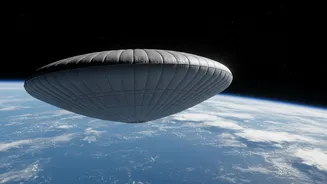
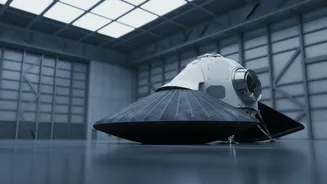
Enter the Hypersonic Inflatable Aerodynamic Decelerator, or HIAD. Developed by NASA over the last two decades, this technology is designed to be packed into a small volume for launch. Shortly before atmospheric entry, it inflates like a high-tech airbag, forming a large, mushroom-shaped shield. One successful demonstration was NASA's LOFTID (Low-Earth Orbit Flight Test of an Inflatable Decelerator) mission, which tested a 6-meter diameter shield. This ability to deploy a shield much larger than the rocket's housing is the technology's core advantage. It fundamentally changes the equation of what can be brought back to Earth or landed on other worlds.
How an Inflatable Shield Survives
The idea of an inflatable object withstanding hypersonic speeds and temperatures hotter than lava seems impossible, but it works by being both a decelerator and a heat shield. The larger surface area creates significantly more drag, allowing the vehicle to slow down much higher in the atmosphere where the air is thinner and generates less intense heat. The shield itself is a marvel of material science. The inflatable structure is made of stacked rings woven from synthetic polymers that are ten times stronger than steel by weight. These are protected by a flexible thermal protection system, including an outer layer of black ceramic fiber cloth and multiple inner layers of insulation that can withstand temperatures over 1600°C.
Bigger, Lighter, and More Capable
The benefits of HIAD technology are transformative for space exploration. Because the shield is lightweight and packable, it frees up valuable mass and volume for more scientific instruments, cargo, or crew supplies. The larger deployed diameter enables the landing of much heavier payloads. While current technology can land about 1.5 metric tons on Mars, human missions will require landing payloads of 20 to 60 metric tons. HIADs are seen as an enabling technology to bridge this gap. Furthermore, this tech opens up new possibilities for missions to planets with dense atmospheres like Venus or moons like Titan, and for commercial applications like returning reusable rocket stages or entire satellites from orbit.