


An 'Almost Total' Eclipse Arrives
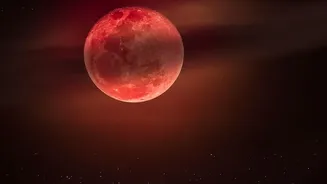
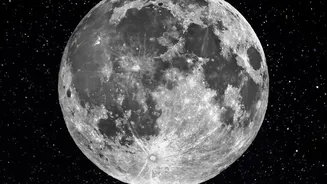
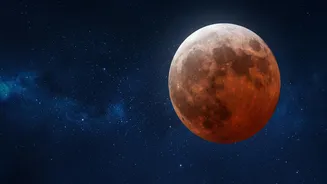
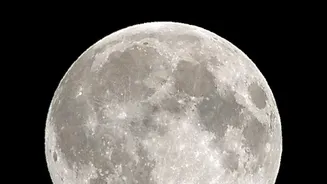
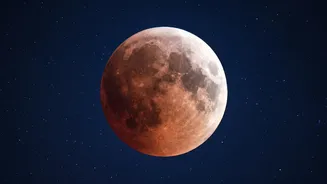
This Friday, August 28, 2026, the cosmos has a special treat: a dramatic and deep partial lunar eclipse. During this event, the full Moon will pass through the Earth's shadow, but this is no ordinary partial eclipse. At its peak, nearly 96% of the lunar surface
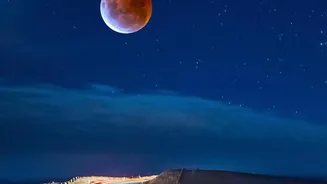
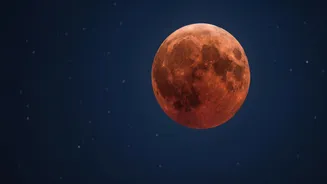
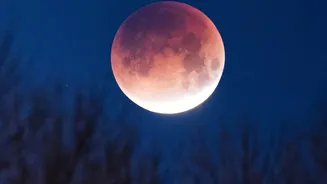
will be covered by the Earth's dark inner shadow, the umbra. This will leave only a tiny sliver of the Moon untouched, causing the eclipsed portion to glow with a faint, coppery-red light. Because it comes so close to being a total eclipse, some are calling it an 'almost blood moon', promising a stunning sight for those in the right locations. The entire celestial alignment will last over five hours from start to finish, with the most dramatic partial phase lasting for more than three hours.
The Key Question: Visibility in India
Here is the critical information for every enthusiast in India: this partial lunar eclipse will not be visible from anywhere in the country. The event occurs entirely during daylight hours for the Indian subcontinent. According to Indian Standard Time (IST), the faint initial phase begins around 6:53 AM, with the more noticeable partial eclipse starting at 8:04 AM. The moment of maximum eclipse happens at 9:43 AM, and the event concludes by 12:32 PM. As the entire spectacle unfolds while the Sun is up in our sky, the Moon will be below the horizon, making it impossible to observe directly.
What Makes This Eclipse Special
A lunar eclipse happens when the Sun, Earth, and Moon align perfectly, with the Earth positioned directly in the middle. This alignment casts Earth's shadow onto the full Moon, temporarily dimming its light. In a partial eclipse, only a part of the Moon enters the darkest portion of Earth's shadow. What makes the August 28 event so notable is its depth. With such a huge portion of the Moon engulfed in shadow, it will be a much more striking sight than a typical partial eclipse. For viewers who can see it, the Moon won't just look like it has a bite taken out of it; it will transform into a deep red crescent, a phenomenon caused by sunlight filtering through Earth's atmosphere and scattering onto the lunar surface.
How to Watch the Spectacle Online
While you can't step outside to see it, you don't have to miss out entirely. Several astronomy organisations and observatories around the world will be hosting free live streams of the eclipse. This is a fantastic way for skywatchers in India to join in on this global event. Websites like Timeanddate.com and the Virtual Telescope Project often provide live feeds. Major observatories located in the visibility path, such as the Griffith Observatory in Los Angeles, are also expected to broadcast the event on their YouTube channels. You can tune in from around 7:30 AM IST to catch the coverage as the Moon begins to enter Earth's shadow.
Eclipse, Raksha Bandhan, and Rituals
The timing of this eclipse has generated extra interest as it coincides with the festival of Raksha Bandhan in India. In Hindu tradition, a visible lunar eclipse (Chandra Grahan) is often associated with a period known as Sutak Kaal, which involves specific rituals. However, it is important to note that because this eclipse is not visible to the naked eye anywhere in India, these observances are not applicable. Astrological and religious guidelines specify that rituals related to an eclipse are only considered when the event is physically visible.