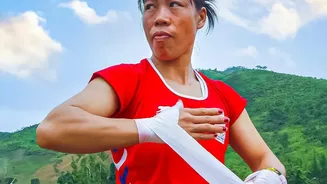







Her story is a testament to the power of pure grit. Mangte Chungneijang Mary Kom, or 'Magnificent Mary', punched her way through poverty and stereotypes to become not just a boxing champion, but a symbol of hope for millions.
From the Fields of Manipur
Born in the small village
of Kangathei in rural Manipur, Mary Kom's early life was one of hardship. Her parents were tenant farmers, and from a young age, she helped them with demanding agricultural chores. This physically taxing work unknowingly built the foundation of stamina and strength that would define her career. Her interest in athletics was sparked by the success of fellow Manipuri boxer Dingko Singh at the 1998 Asian Games. Inspired, she decided to channel her energy into boxing, a decision she initially kept secret from her family who feared it was not a suitable pursuit for a young woman.
Defying Doubts and Dominating the Ring
Mary Kom's passion for boxing was undeniable. She moved to Imphal to train, where her dedication quickly became apparent to her coaches. After she won the state boxing championship in 2000, a newspaper photograph revealed her secret to her father. Seeing her determination, his initial reservations turned into support. Her ascent was rapid. She won her first World Championship silver in 2001 and followed it up with a gold in 2002, marking the beginning of an era of dominance. She went on to win a total of six World Championship titles, a feat no other female boxer has matched.
The Mother of All Comebacks
Perhaps the most inspiring chapter of Mary's journey was her comeback after marriage and childbirth. After marrying in 2005, she took a brief hiatus and gave birth to twins in 2007. Many believed her career was over, especially after a C-section delivery. However, Mary Kom defied all expectations. She returned to the ring with renewed determination, winning her fourth World Championship gold in 2008. This was not just a victory; it was a powerful statement that a woman could be a mother and a world champion simultaneously. She would prove this again after the birth of her third son.
An Olympic Dream and a Lasting Legacy
When women's boxing was introduced at the London 2012 Olympics, Mary Kom became the first Indian woman boxer to qualify. She fought her way to a historic bronze medal, a landmark moment for Indian sports. Her list of accolades is staggering: gold medals at the Asian Games and Commonwealth Games, and numerous national honours including the Padma Vibhushan, India's second-highest civilian award. Beyond the medals, her legacy lies in the path she cleared for future generations. She established the Mary Kom Regional Boxing Foundation to train aspiring athletes and served as a Member of Parliament, advocating for sports and women's empowerment.