



A Sudden Cosmic Glow-Up
In late 2019, a previously unremarkable galaxy named SDSS1335+0728, located in the Virgo constellation, began to shine brighter than ever before. This wasn't a flicker; it was a fundamental change. Data from multiple observatories, including the European
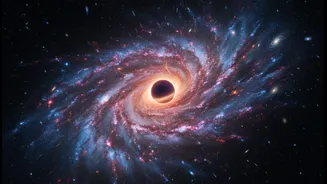
Southern Observatory's Very Large Telescope, confirmed the galaxy's core was radiating significantly more light across ultraviolet, optical, and infrared wavelengths. By February 2024, it even started emitting X-rays. Unlike temporary events like a supernova explosion or a star being torn apart (a tidal disruption event), which fade within months, this galaxy is still getting brighter more than four years later. This unprecedented behaviour has led astronomers to a stunning conclusion: they are likely witnessing the birth of an Active Galactic Nucleus (AGN) in real-time.
What Are Sleeping Black Holes?
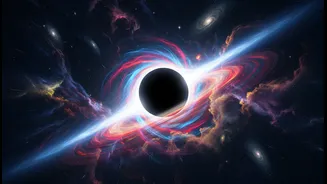
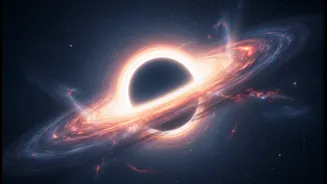
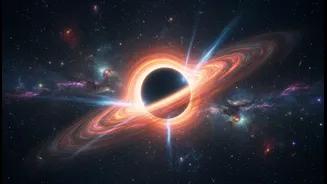
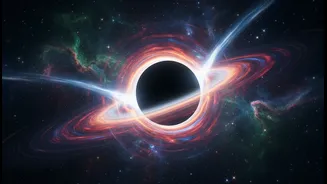
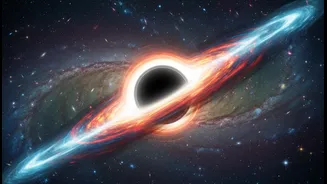
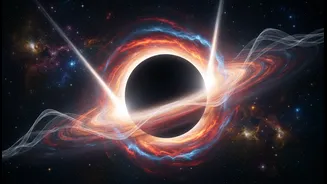
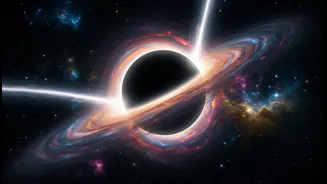
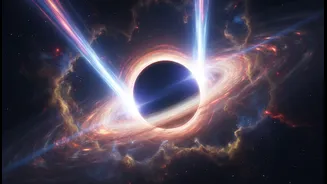
At the heart of most large galaxies, including our own Milky Way, lurks a supermassive black hole (SMBH) – a cosmic monster with a mass hundreds of thousands to billions of times that of our sun. Despite their fearsome reputation for swallowing everything, most SMBHs are dormant, or 'sleeping'. They are not actively feeding on large amounts of gas and dust. A black hole itself is invisible because its gravity is so strong that not even light can escape. We only 'see' them by the effect they have on their surroundings. When a large amount of material falls toward a black hole, it forms a swirling, superheated disk called an accretion disk. This disk glows intensely, creating the bright spectacle known as an AGN. Until now, the transition from a quiet, sleeping state to a brilliantly active one was a process only seen in theories and after the fact, never as it happened.
An Unprecedented Awakening
This event is a first for astronomy. While scientists have seen galaxies switch between active and inactive states before, those observations always caught the galaxy long after the change occurred. The 'awakening' of SDSS1335+0728 is the first time the process has been observed as it unfolds. “Imagine you've been observing a distant galaxy for years, and it always seemed calm and inactive,” says Paula Sánchez Sáez, an astronomer at ESO and the lead author of the study. “Suddenly, its core starts showing dramatic changes in brightness, unlike any typical events we've seen before.” The sustained and increasing brightness rules out most common explanations, leaving the activation of the central black hole as the most plausible cause.
What Woke the Giant?
So, what could flip the 'on' switch for a black hole a million times more massive than the sun? Astronomers are considering a few possibilities. The leading theory is that the black hole has begun to feast on a vast supply of gas that has become available in its vicinity. What triggered this feast is still a mystery. It could be the natural evolution of the galaxy, where gas clouds finally spiral into the centre. Another possibility is a more dramatic event, like a collision with a smaller galaxy that pushes material toward the black hole. While they are still collecting data, scientists are also considering a more exotic explanation: an unusually long and slow tidal disruption event, where a star is gradually torn apart over years instead of months. If this is the case, it would be the longest and faintest such event ever recorded.
Why This Discovery Matters
Observing a black hole's activation is more than just a cosmic light show; it's a golden opportunity to understand how these giants grow and influence their host galaxies. Active black holes can release powerful jets of energy that can shape star formation across the entire galaxy. By watching this process from the very beginning, scientists can test their theories about galaxy evolution in a way they never could before. “Regardless of the nature of the variations, [this galaxy] provides valuable information on how black holes grow and evolve,” says Sánchez Sáez. It’s a real-time natural laboratory for some of the most fundamental questions in astrophysics. And yes, astronomers even note that our own galaxy's black hole, Sagittarius A*, could theoretically undergo a similar awakening, though the probability is unclear.