



The Eclipse You Can't See
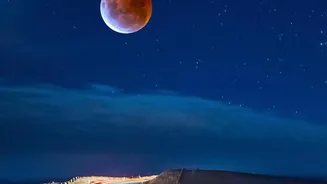
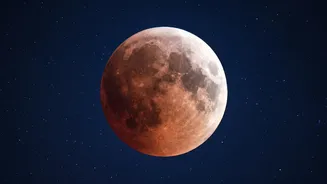
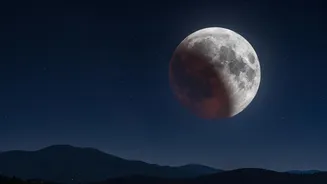
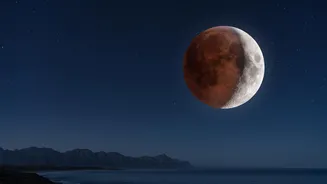
A deep partial lunar eclipse is set to occur on Friday, August 28, 2026. At its peak, about 96% of the Moon's surface will be covered by Earth's darkest shadow, the umbra, creating what some are calling an "almost Blood Moon." This dramatic event has
generated considerable interest, especially as it coincides with the festival of Raksha Bandhan in India. However, the entire eclipse takes place during daytime hours in India, with the peak occurring around 9:43 AM IST. Since the Moon will be below the horizon, it will be impossible to view from anywhere in the country, including major cities like Delhi and Mumbai. The best views will be in North and South America, with parts of Europe and Africa also getting a glimpse.
So, What Exactly Is a Lunar Eclipse?
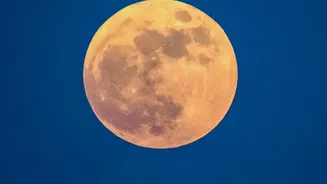
A lunar eclipse is a beautiful astronomical event that happens when the Earth passes directly between the Sun and the Moon. In this alignment, our planet casts a shadow that falls upon the lunar surface, dimming its appearance. This can only occur during a full moon, when the Moon is opposite the Sun in the sky. However, because the Moon's orbit is slightly tilted compared to Earth's, we don't get an eclipse every full moon. Most of the time, the Moon passes just above or below Earth's shadow. A few times a year, the alignment is perfect, and we get to witness this celestial display.
A Guide to Eclipse Types
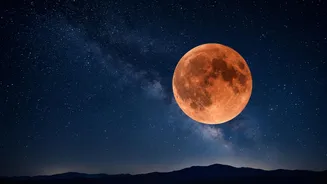
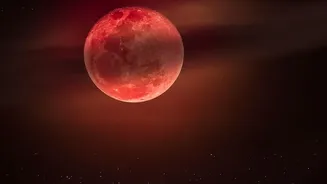
Not all lunar eclipses are the same. They come in three main varieties, depending on which part of Earth's shadow the Moon passes through. The shadow has two parts: the penumbra (the faint, outer shadow) and the umbra (the dark, inner shadow). A penumbral eclipse occurs when the Moon only passes through the faint penumbral shadow. These are often subtle and hard to notice. A partial lunar eclipse, like the one on August 28, happens when a portion of the Moon enters the dark umbra. These are easily visible to the naked eye. A total lunar eclipse is the most dramatic, occurring when the entire Moon passes through the umbra. During totality, the Moon can turn a stunning reddish-orange, often called a "Blood Moon."
When Is the Next Lunar Eclipse Visible From India?
While the August 28 event is a no-show for India, you won't have to wait forever. The next lunar eclipse visible from India will be a partial one on the night of September 7-8, 2026. After that, a total lunar eclipse will be visible from most of India on December 31, 2028. These events offer a fantastic opportunity for sky-watchers across the country to witness the spectacle firsthand. Mark your calendars for these future dates to ensure you don't miss out.
How to Watch a Lunar Eclipse
The best part about lunar eclipses is how easy and safe they are to watch. Unlike a solar eclipse, which requires special protective glasses, you can view a lunar eclipse with your naked eyes without any risk. For an even better experience, find a location with a clear view of the sky, away from bright city lights. While no special equipment is necessary, using a pair of binoculars or a small telescope can offer a breathtaking, close-up view of the Earth's curved shadow moving across the craters of the Moon. The key is simply to be patient and look up as the event unfolds.