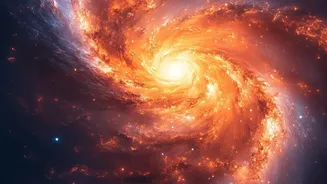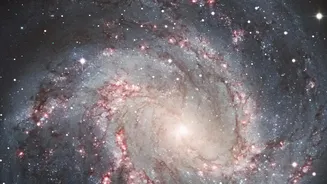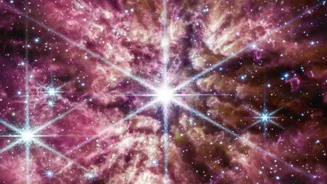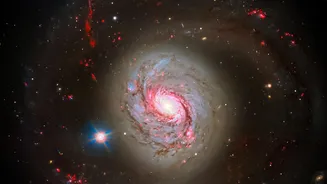



A New Window on the Cosmos
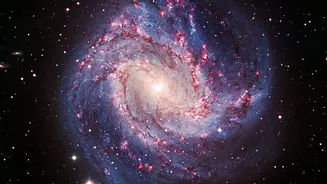
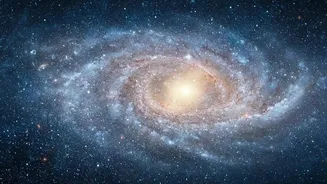
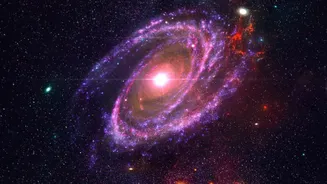
Humanity has a powerful new eye on the universe, and it is changing everything. Thanks to the unprecedented capabilities of the James Webb Space Telescope (JWST), astronomers are capturing images that are not just beautiful, but revolutionary. The JWST is designed
to see the universe in infrared light, which is invisible to the human eye. This allows it to peer through the cosmic dust that obscures the view of other telescopes and, more importantly, to look back in time. Because light from distant objects takes billions of years to reach us, seeing a faraway galaxy is like looking at a photograph from the deep past. The latest batch of images provides the sharpest views yet into the formative years of the universe, revealing the complex processes that govern how galaxies are born, evolve, and die.
Galactic Crashes and Cosmic Archaeology
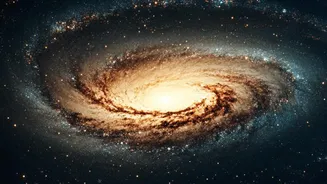
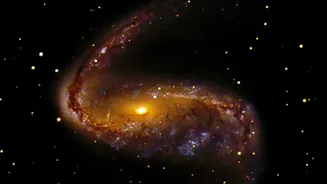
Some of the most dramatic new images showcase the aftermath of galactic collisions. One recent image of Centaurus A, a relatively nearby galaxy, cuts through its dusty core to reveal the chaotic and beautiful consequences of a merger with another galaxy that happened two billion years ago. This is cosmic archaeology on a grand scale. Astronomers can see the lingering scars of this ancient crash, providing a powerful laboratory for understanding how such events trigger bursts of new star formation while also feeding the supermassive black hole at the galaxy's centre. The JWST's sensitivity allows it to detect faint, extended structures around galaxies—like tidal tails and shells of stars—that act as a fossil record of their past interactions. These details were previously impossible to see clearly, but now provide a roadmap for how galaxies, including our own Milky Way, have grown over billions of years by consuming smaller ones.
Rewriting the Story of the Early Universe
Perhaps the most startling discoveries are those that challenge existing theories. The JWST is finding galaxies in the early universe that are far more massive and mature than our models predicted should be possible. One galaxy cluster, XLSSC 122, appears surprisingly well-developed for its age, seen as it was over 10 billion years ago. This has left astronomers scrambling to explain how such a massive structure could have formed so quickly after the Big Bang. Another puzzle comes from objects nicknamed "Little Red Dots," which appear to be very early galaxies hosting supermassive black holes. The existence of these massive black holes so early in cosmic history raises fundamental questions about how they could have grown so large, so fast. These findings don't break our understanding of physics, but they do show that the story of the early universe is more complex and dynamic than we ever imagined.
The Engines of Creation and Destruction
The new images are also providing stunning clarity on the dual role of supermassive black holes. We now have clearer evidence that while these cosmic engines power some of the most luminous objects in the universe, known as quasars, they also have the power to shut down star formation entirely. Recent observations of a distant galaxy nicknamed the "Red Potato" show how energetic activity from its central black hole is blowing away the gas needed to create new stars. At the same time, by studying how dust was created in the early cosmos, scientists are learning how the very first stars lived and died, seeding the universe with the heavy elements needed for later generations of stars, planets, and even life. These images are showing us the intricate, often violent, dance between creation and destruction that shapes the cosmos.