








A World Ripe for Discovery
Titan is one of the most fascinating bodies in our solar system. It’s an ocean world with a thick, nitrogen-rich atmosphere, weather systems, and a landscape shaped by liquid methane rain that forms rivers, lakes, and seas. Scientists are captivated by Titan because
its environment may be similar to early Earth before life emerged. It’s a giant, natural laboratory for studying prebiotic chemistry—the chemical steps that may lead to life. The surface is rich in complex organic materials, and there is evidence of a liquid water ocean beneath its icy shell. This unique combination of ingredients for life makes it a top priority for astrobiology research, and Dragonfly is designed to investigate it by visiting multiple sites.
An Aviator's Paradise, If You Can Stand the Cold
Flying on Titan presents a strange mix of advantages and extreme challenges. The moon's atmosphere is four times denser than Earth's, while its gravity is only about one-seventh as strong. This combination makes flight incredibly efficient; it's about 40 times easier to fly there than here. However, the main obstacle is the brutal cold. The average surface temperature is a bone-chilling minus 179 degrees Celsius. At this temperature, materials can become brittle, electronics fail, and power sources are difficult to maintain. Engineers must design every component, from the rotors to the scientific instruments, to withstand and operate in this deep freeze for years. The craft must also be insulated to keep its internal systems at a functional temperature.
The Anatomy of a Moon-Hopping Drone
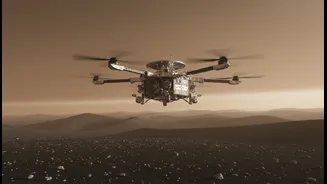
Dragonfly is not a simple drone; it's a 450-kilogram, car-sized octocopter, meaning it uses eight rotors for flight. This dual-quadcopter design provides redundancy, allowing it to fly even if it loses a motor or rotor. Since sunlight is too weak for solar power on Titan, Dragonfly will be powered by a Multi-Mission Radioisotope Thermoelectric Generator (MMRTG). This nuclear power source uses the heat from decaying plutonium to generate electricity, keeping the craft powered and its instruments warm, day and night. During its 3.3-year primary mission, Dragonfly will perform a series of 'hops', flying to new locations every Titan day (about 16 Earth days). It will travel further than all previous Mars rovers combined, drilling for samples at diverse locations to be analyzed by its onboard mass spectrometer.
Rehearsing for Titan on Earth
Before Dragonfly can fly on Titan, engineers must prove it works on Earth. This is where the "is showing" part of the story comes alive. At facilities like the Johns Hopkins Applied Physics Laboratory (APL) and NASA's Langley Research Center, the team is subjecting Dragonfly's components to rigorous testing. They have built massive thermal vacuum chambers to simulate Titan's frigid temperatures and dense atmosphere. In recent tests, engineers have put a full-scale model of the rotorcraft through vibration tests to ensure it can survive the bone-rattling launch and landing sequences. They've spun the rotors in wind tunnels filled with a heavy gas to mimic Titan's thick air, measuring stresses and performance to validate their flight models. These Earth-based trials are crucial for refining the design and ensuring the mission's success when Dragonfly finally arrives at Titan in 2034.