
For decades, we have understood the universe to be about 13.8 billion years old. Now, a new cosmological model is challenging that fundamental number, proposing the cosmos is nearly twice as old, and it's beginning to pass some early tests.
The Universe We Thought We Knew
Our current
and most widely accepted understanding of the universe is called the Lambda Cold Dark Matter (ΛCDM) model. It has been incredibly successful, explaining observations of the cosmic microwave background—the faint afterglow of the Big Bang—and the large-scale structure of galaxies. This model calculates that the universe began with the Big Bang approximately 13.8 billion years ago. A key part of this model involves two mysterious components: dark matter and dark energy. Dark matter is the unseen 'scaffolding' that provides the extra gravity needed to hold galaxies together, while dark energy is the force thought to be causing the universe's expansion to accelerate. Together, they are believed to make up about 95% of the cosmos, yet neither has ever been directly detected.
Cracks in the Standard Model
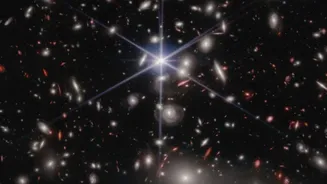
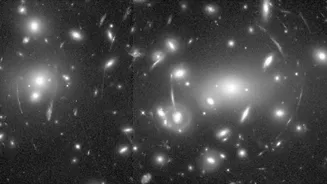
In recent years, observations from the James Webb Space Telescope (JWST) have presented a significant puzzle. The powerful telescope has spotted galaxies in the very early universe that appear surprisingly massive and mature. According to the standard 13.8-billion-year timeline, these galaxies existed when the universe was just a few hundred million years old. This leaves astronomers struggling to explain how such large, well-structured galaxies could have formed so quickly. This 'impossible early galaxy problem' has renewed interest in alternative cosmological theories that could provide a solution.
A Radically Older Cosmos
One such alternative comes from Rajendra Gupta, an adjunct professor of physics at the University of Ottawa. He has developed a model that puts the age of the universe at 26.7 billion years. This extended timeline could easily account for the mature galaxies seen by the JWST. In Gupta's model, a galaxy observed at a point where the standard model says the universe is 300 million years old would actually be in a universe that is already 4.6 billion years old, providing ample time for it to grow and evolve. As Gupta puts it, 'Impossible early galaxies become predictable galaxies'.
Combining Old and New Ideas
Gupta's model is called CCC+TL, which stands for Covarying Coupling Constants plus Tired Light. It's a hybrid that combines and revives two older ideas. The 'Tired Light' (TL) concept, first proposed by Fritz Zwicky in 1929, suggests that light particles (photons) lose energy as they travel across vast cosmic distances. The second idea, Covarying Coupling Constants (CCC), proposes that the fundamental constants of nature—the forces that govern interactions between particles—are not fixed but change slowly over cosmic history. By combining these ideas, the CCC+TL model offers a universe that doesn't require dark matter or dark energy to explain observations like galaxy rotation and cosmic expansion.
Passing the First Hurdles
The headline-making news is that this model has reportedly passed several cosmological tests. According to recent announcements, the CCC+TL model is consistent with observations of the abundance of light elements created after the Big Bang and can reproduce the rotation of 175 different galaxies without needing to invoke dark matter. While some of these findings are still preliminary or under peer review, they represent a crucial first step for any new theory hoping to challenge the established paradigm. The theory offers a different interpretation of phenomena typically attributed to dark matter and energy, suggesting they may instead be the result of the physical constants themselves evolving over time.