




A Monsoon in Flux
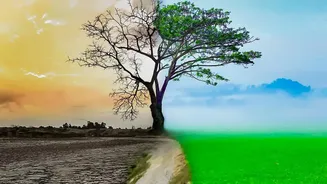
India's lifeline, the monsoon, is becoming increasingly erratic. Scientists observe that it's not simply a case of more or less rain, but a fundamental change in its character. Extreme rainfall events are becoming more intense and frequent, while the periods
between them are stretching into longer, drier spells. A 2026 study highlighted that climate change is creating a "dual threat" of extreme humid heat and unpredictable rain. This volatility is felt across the subcontinent, from the central Indian highlands to the lush Western Ghats, disrupting patterns that have governed these landscapes for millennia. For instance, studies have noted a significant rise in extreme weather events over central India, coupled with a weakening of the overall monsoon. This new reality of 'drought and deluge' sets a challenging stage for the country's vast and varied forest ecosystems.
Forests Under Stress
India's forests are finely tuned to specific moisture levels, and the changing rainfall is pushing them to their limits. Dry deciduous forests, which are naturally adapted to seasonal dryness, are proving especially vulnerable. One study in Madhya Pradesh's Panchmarhi Biosphere Reserve found that dry teak forests saw the highest loss in canopy cover, as rising temperatures and shifting rains made them more susceptible to moisture stress. The combination of prolonged droughts and high heat prevents trees from cooling themselves effectively, which can lead to widespread damage and even large-scale forest die-offs. This stress also increases the risk of forest fires, with hot and dry conditions creating more flammable biomass. The result is a gradual but definite transformation, where once-dense forest patches degrade into scrubland, altering the very fabric of the ecosystem.
A Cascade of Consequences for Wildlife
The impact of erratic rainfall cascades through the entire food web, affecting countless species that depend on the forest's stability. In the Western Ghats, a recent break in the monsoon was observed to have dried up entire egg clutches of the rare Matheran Wrinkled Frog, which lays its shell-less eggs on damp rocks and depends on continuous humidity to reproduce. Amphibians, with their permeable skin and reliance on moist environments, are often the first to suffer from such climatic shifts. The consequences extend to larger animals as well. A July 2026 study warned that shifting rain patterns and shrinking habitats in the southern Western Ghats will likely push more elephants into human settlements by 2030, as they are forced to travel farther for food and water. These changes disrupt ancient migratory routes and create new flashpoints for human-wildlife conflict.
A New Wave of Scientific Inquiry
The alarming changes have spurred a new wave of research interest in India's forest ecology. Scientists are employing advanced tools to understand and predict the future of these vital ecosystems. Using a combination of satellite data, climate modelling, and on-ground observations, researchers are piecing together a more granular picture of how different forests will respond. For the first time, advanced vegetation models developed abroad are being applied specifically to the Indian subcontinent to forecast changes in carbon storage. Recent studies have focused on everything from how phenology—the timing of life cycle events like leafing and flowering—is being disrupted by moisture stress, to how forest carbon stocks might change under different emissions scenarios. This renewed focus is not just academic; it aims to provide the critical data needed for effective, forward-looking conservation.
From Research to Resilience
The ultimate goal of this new research is to build resilience. Understanding which forests are most vulnerable allows for targeted conservation efforts and better management strategies. For example, findings about increased fire risk can inform fire prevention policies, while data on how specific tree species respond to drought can guide reforestation projects. Some studies even suggest that under certain climate scenarios, some Indian forests might be able to store more carbon, highlighting the complex and sometimes counterintuitive responses of nature. However, experts caution that this potential should not lead to complacency. Protecting biodiversity remains key, as more diverse forests are better equipped to withstand shocks. By translating these scientific insights into actionable policy, there is hope to safeguard these ecosystems for future generations.