




Taming the Cosmic Data Tsunami
Today's astronomical surveys are technological marvels, capable of generating astonishing amounts of data. The Vera C. Rubin Observatory in Chile, for example, is set to capture around 20 terabytes of data every single night, which is like streaming high-definition
movies for over two years. Over its planned ten-year survey, it will produce a catalog of roughly 20 billion galaxies and a similar number of stars. This firehose of information is far too vast for humans to analyze manually. It would take an army of astronomers centuries to classify every object. This is where machine learning (ML) steps in, providing the essential tools to manage and interpret this cosmic flood, transforming a potential data crisis into an opportunity for discovery.
The Ultimate Sorting Hat for Galaxies
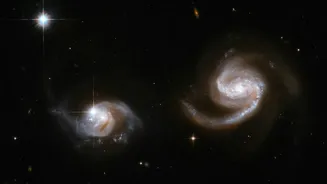
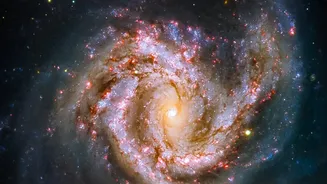
One of the most fundamental tasks in astronomy is classification. Is that fuzzy blob a spiral galaxy like our own Milky Way, an elliptical one, or something more irregular? This classification, known as morphology, provides crucial clues about a galaxy's formation and evolutionary history. Traditionally, this was a painstaking process done by human experts. Machine learning, particularly using models called convolutional neural networks (CNNs), has automated this process with remarkable accuracy. These algorithms can be trained on millions of labeled images from projects like the Sloan Digital Sky Survey and then set loose on new data, categorizing galaxies far faster and more consistently than any human could. This allows scientists to build massive, detailed maps of the cosmos and study galactic evolution on an unprecedented scale.
Finding Needles in a Cosmic Haystack
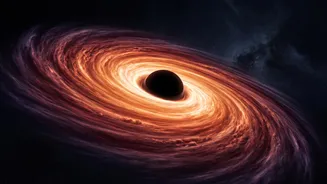
The universe is dynamic, with stars that explode (supernovae), flare up, or get torn apart by black holes. These are known as 'transient events', and they are often rare and fleeting. Large surveys are designed to scan the sky repeatedly to catch these changes, but this generates millions of potential alerts each night. The problem is that many of these alerts are not real astronomical events but instrumental noise or atmospheric effects—what astronomers call 'bogus' candidates. Machine learning algorithms are now indispensable for sifting through this noise. Trained to distinguish the signature of a real astrophysical event from an artifact, these 'real/bogus' classifiers act as an automated triage system, flagging only the most promising candidates for human follow-up. This ensures that astronomers can focus their limited telescope time on observing genuinely interesting and scientifically valuable events.
Accelerating the Hunt for New Worlds
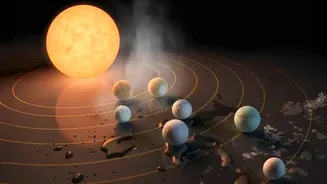
The search for planets outside our solar system, or exoplanets, has become a major focus of modern astronomy. One of the primary methods for finding them is the transit method, which looks for tiny, periodic dips in a star's light caused by an orbiting planet passing in front of it. However, these dips are often subtle and can be easily lost in the noise of a star's natural variability. Manually scanning light curves—graphs of a star's brightness over time—is slow and prone to error. Machine learning models, including gradient boosting classifiers and neural networks, have proven to be exceptionally good at this task. They can be trained on thousands of known light curves from missions like Kepler and TESS, learning to recognize the faint, characteristic signature of a planetary transit with high accuracy and recall. This has dramatically accelerated the rate of exoplanet discovery and confirmation.
Powering the Next Generation of Discovery
The synergy between ML and astronomy is most apparent in next-generation projects like the Rubin Observatory's Legacy Survey of Space and Time (LSST). Machine learning is not just an add-on; it's woven into the very fabric of the observatory's operations. Software platforms known as 'brokers' will use ML algorithms to filter, sort, and classify the millions of nightly alerts in near real-time. AI is also used to help the telescope itself perform better, for instance by correcting for atmospheric turbulence to ensure images are as sharp as possible. This deep integration allows the observatory to move beyond just managing data to actively enabling new science, such as finding rare objects and anomalies that might lead to entirely new discoveries.