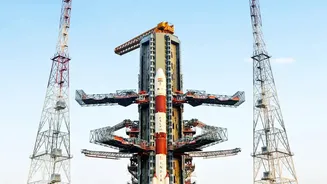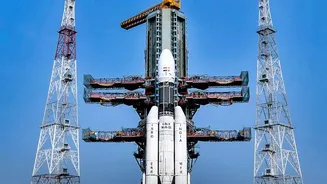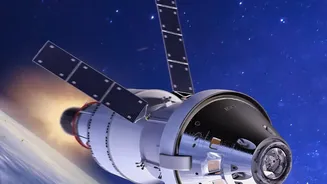

The Ultimate Ejection Seat
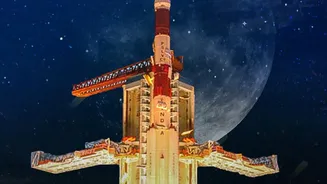
At the heart of Gaganyaan's safety protocol is the Crew Escape System (CES). Think of it as the most advanced ejection seat ever built. Its sole purpose is to pull the crew module—the capsule carrying the astronauts—away from the main rocket in a fraction
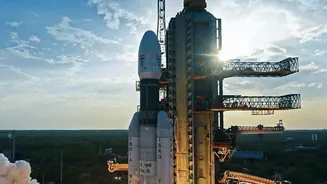
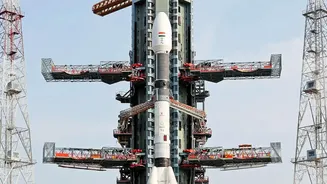
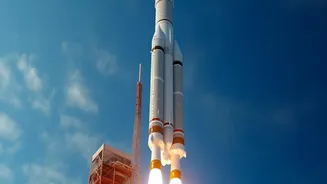
of a second if anything goes wrong during the launch phase. This system sits atop the human-rated LVM3 rocket like a sharp turret, ready to fire at a moment's notice. Unlike pusher-type systems seen on some spacecraft that push the capsule from below, ISRO chose a puller or 'tractor' design, similar to the Apollo and Soyuz missions, to yank the crew clear of danger.
Ready for Any Emergency
A launch can go wrong in two critical phases: on the launchpad itself or during the intense ascent into orbit. The CES is designed for both scenarios. A 'Pad Abort' would be triggered if a catastrophic failure occurs moments after ignition, while the rocket is still on or near the ground. In this situation, powerful motors would ignite instantly to propel the crew module to a safe altitude and distance before it parachutes down. An 'In-flight Abort' handles emergencies during ascent, a phase of extreme aerodynamic pressure. An intelligent, automated health monitoring system constantly checks the rocket’s vital signs. If it detects a critical anomaly, the CES is activated automatically.
The Mechanics of a Split-Second Escape
How does it work so fast? The CES uses a cluster of special-purpose, quick-acting solid motors. These aren't like normal rocket engines; they are packed with high-burn-rate propellants designed to generate immense thrust almost instantly. When triggered, these motors fire together to pull the crew module with an acceleration far greater than the launch vehicle itself, ensuring a rapid separation. Once the capsule is a safe distance away, the escape system jettisons, and a sequence of parachutes deploys automatically. This multi-stage parachute system, involving drogue and main chutes, slows the module's descent for a gentle splashdown in the ocean, where recovery teams await.
Tested, Tested, and Tested Again
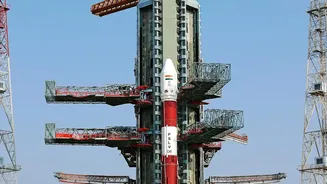
An escape system is only as good as its reliability, which is why ISRO has subjected the CES to a gruelling series of tests. A key milestone was the Pad Abort Test in 2018, which successfully demonstrated the system's ability to pull a 12.6-tonne simulated crew module to safety from the launchpad. More recently, the Test Vehicle Abort Mission-1 (TV-D1) in October 2023 tested an in-flight abort scenario. A specially designed test rocket carried the module to an altitude of about 17 km, where the escape sequence was deliberately triggered, proving the system works under realistic flight conditions. Several more abort tests are planned to validate the system across all possible failure scenarios before any astronaut flies.
A Broader Culture of Safety
While the Crew Escape System is the most dramatic safety feature, it's part of a much wider safety-first philosophy for the Gaganyaan mission. The LVM3 rocket has been 'human-rated', meaning its systems have been re-configured with redundancies and higher reliability standards. Beyond the launch, ISRO has also tested crucial systems for the return journey, which is considered the most complex phase of the mission. This includes the Crew Module Up-righting System, which uses inflatable bags to ensure the capsule stays upright after splashing down in the sea, and systems that ensure a clean separation from the service module before re-entry. Every phase of the mission, from launch to landing, has been meticulously planned and tested to protect India's pioneering Vyomanauts.