






The Air Quality Index, or AQI, is a number we see daily, but what does it really mean? Understanding how this vital metric is measured and what its numbers signify is key to protecting your health, especially during high-pollution seasons.
The 'Health Trackers' for Our Air
An Air Quality
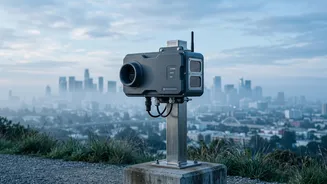
Monitoring Station is essentially a health tracker for the atmosphere. These stations, set up in various locations across cities, continuously draw in ambient air to measure the concentration of specific pollutants. They are the primary source of the data that ultimately becomes the single AQI number you see on apps and news reports. Without these stations, we would have no reliable, real-time measure of the air we breathe.
Inside the Monitoring Station
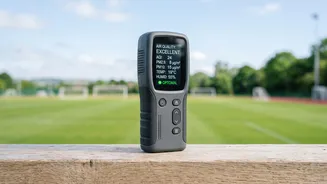
These stations use a variety of sophisticated sensors to analyze the air. For particulate matter like PM2.5 and PM10, many stations use optical sensors that employ a laser scattering principle. When airborne particles pass through a laser beam, they scatter the light, and the sensor measures this scattered light to calculate the concentration of particles. For gaseous pollutants like Nitrogen Dioxide (NO2) and Carbon Monoxide (CO), stations often use electrochemical sensors. These work on the principle that specific gases cause a chemical reaction on the sensor's surface, which generates a small electrical current proportional to the gas's concentration. The station's equipment logs all this data and transmits it to a central server for processing.
The Eight Pollutants India Tracks
India's National Air Quality Index (AQI) was launched in 2014 and is based on the measurement of eight key pollutants. These are Particulate Matter (PM10 and PM2.5), Nitrogen Dioxide (NO2), Sulphur Dioxide (SO2), Carbon Monoxide (CO), Ozone (O3), Ammonia (NH3), and Lead (Pb). These pollutants come from a variety of sources, including vehicle emissions, industrial processes, construction dust, and the burning of fossil fuels. To calculate the final AQI, data must be available for at least three of these pollutants, one of which must be either PM2.5 or PM10.
From 8 Pollutants to 1 Number
The magic of the AQI is turning complex data from eight different pollutants into one simple number. This is done by calculating a 'sub-index' for each measured pollutant. The final AQI reported for a location is not an average; instead, it is the highest of all the individual sub-index values. For example, if the sub-index for PM2.5 is 170 (Moderate) but the sub_index for Ozone is 80 (Satisfactory), the overall AQI for that time will be reported as 170. This 'worst_pollutant_wins' approach ensures that the index always reflects the biggest immediate health risk.
Decoding AQI Categories and Colours
India's Central Pollution Control Board (CPCB) has classified the AQI into six categories, each with a corresponding colour and number range, to make it easy for the public to understand. These are:
- 0–50 (Good - Green): Minimal health impact.
- 51–100 (Satisfactory - Light Green): May cause minor breathing discomfort to sensitive people.
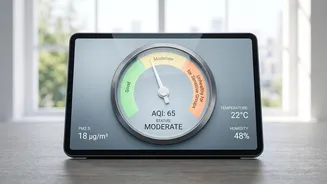
- 101–200 (Moderate - Yellow): Can cause breathing discomfort to people with lung diseases, asthma, and heart conditions.
- 201–300 (Poor - Orange): May cause breathing discomfort to most people on prolonged exposure.
- 301–400 (Very Poor - Red): Can cause respiratory illness on prolonged exposure.
- 401–500+ (Severe - Dark Red): Affects healthy people and seriously impacts those with existing diseases.
What You Should Do at Each Level
The AQI is a practical tool for making daily decisions. In the 'Good' and 'Satisfactory' ranges, outdoor activities are generally safe for everyone. When the AQI enters the 'Moderate' category, sensitive groups—like children, the elderly, and people with respiratory or heart conditions—should consider reducing prolonged or heavy exertion outdoors. In the 'Poor' and 'Very Poor' ranges, everyone should reduce heavy outdoor exertion, and sensitive groups should avoid it altogether. When the AQI is 'Severe', everyone should avoid all outdoor physical activity. Using an air purifier indoors can also help reduce exposure during these times.