




The Universe’s Baby Picture
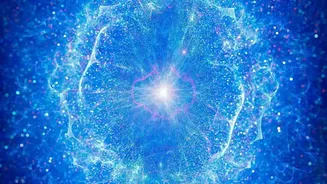
Imagine being able to see a photo of the universe when it was just a baby. That's essentially what the Cosmic Microwave Background, or CMB, is. This faint glow of radiation fills all of space and is the leftover heat from the Big Bang, which occurred
nearly 14 billion years ago. For the first 380,000 years, the universe was a hot, dense soup of particles and energy, so dense that light couldn't travel freely. Once it cooled enough, the first atoms formed and light was set free. That light, the CMB, has been travelling across the cosmos ever since, carrying with it a snapshot of the early universe. By studying its tiny temperature and polarization variations, scientists can learn about the conditions at the dawn of time.
The Dark Side of the Cosmos
Our standard model of cosmology tells us that the stars, planets, and galaxies we can see make up only about 5% of the universe. The rest is composed of two enigmatic substances: dark matter and dark energy. Dark matter, which makes up about 27% of the cosmos, is an invisible substance that doesn't emit or reflect light. We know it exists because of its gravitational pull on visible matter; it's the invisible scaffolding that holds galaxies and galaxy clusters together. Dark energy, making up the remaining 68%, is even more mysterious. It's the name given to the unknown force that is causing the expansion of the universe to accelerate. Essentially, most of our universe is made of stuff we can't see and don't understand.
Using Ancient Light as a Lens
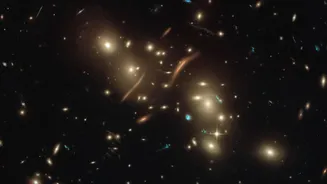
So how can the oldest light in the universe tell us about invisible matter? The answer lies in a phenomenon predicted by Albert Einstein: gravitational lensing. According to his theory of general relativity, massive objects bend the fabric of spacetime. As the CMB light travels across billions of years, its path is slightly bent and distorted every time it passes by a massive structure, like a galaxy or a cluster of galaxies, which are themselves held together by vast amounts of dark matter. By studying these tiny distortions in the CMB's otherwise uniform pattern, scientists can create a map of all the matter — both visible and dark — that the light has encountered on its journey to us.
New Maps of the Invisible Universe
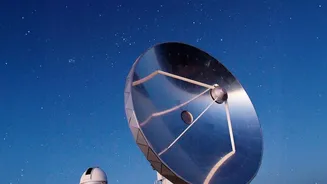
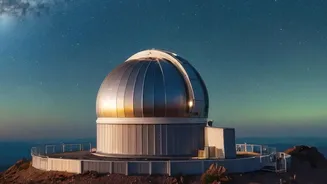
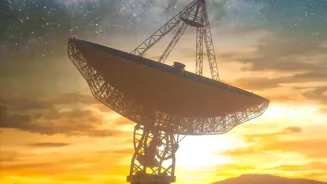
This is exactly what powerful experiments like the South Pole Telescope (SPT) and the Atacama Cosmology Telescope (ACT) are doing. Taking advantage of the clear, dry skies in Antarctica and the Chilean desert, these telescopes are designed to capture the CMB with incredible sensitivity. Recent analyses of data have produced the sharpest and clearest maps of matter distribution across the universe. By charting the lensing of the CMB, researchers can effectively 'weigh' the universe and trace where dark matter is concentrated. These new results from the SPT, for instance, have confirmed that the observed lensing patterns align perfectly with what Einstein's general relativity predicts, strengthening our confidence in the current cosmological model.
What This Means for Science
These new, high-resolution maps are more than just pretty pictures; they are powerful tools for testing our fundamental understanding of the cosmos. By comparing the distribution of dark matter with our theories of cosmic evolution, scientists can refine their models. The data helps constrain the properties of dark energy and even probe the mass of mysterious particles like neutrinos. While these findings largely confirm the standard model of cosmology, they also provide crucial data points that could help solve lingering puzzles, like the 'Hubble tension' — a disagreement over the universe's exact expansion rate. As more data is analysed, scientists hope to move from simply mapping dark matter to finally understanding its fundamental nature.