




The Cosmic Data Deluge
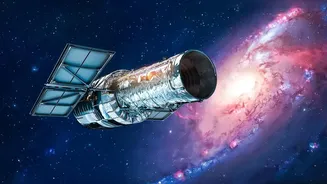
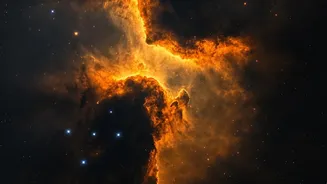
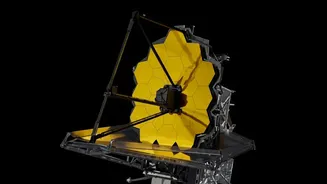
Our view of the cosmos has never been clearer, thanks to powerful observatories like the James Webb and Hubble Space Telescopes. These technological marvels beam back staggering amounts of data, capturing everything from the birth of stars to the faint
light of the universe's first galaxies. But this success has created a new problem. The sheer volume of information—terabytes upon terabytes of images and light readings—is far too vast for human astronomers to analyze manually. Finding a single exoplanet or a rare galactic merger in this ocean of data has become the modern equivalent of finding a needle in a cosmic haystack. It's a challenge that threatens to slow the pace of discovery, as precious signals remain buried in the archives.
Enter the AI Astronomer
This is where artificial intelligence comes in. NASA has been increasingly turning to machine learning—a subset of AI where computers learn to recognize patterns—to act as an expert partner for its scientists. These AI models are trained on massive, curated datasets. For example, an AI can be shown thousands of known light curves from the Kepler mission—the characteristic dip in a star's brightness caused by a planet passing in front of it. By studying these examples, the AI 'learns' to distinguish the subtle signature of a transiting exoplanet from instrumental noise or other cosmic phenomena. Once trained, these algorithms can sift through new, unanalyzed data at incredible speeds, flagging potential discoveries for human verification.
Hunting for Hidden Worlds
The search for exoplanets has been revolutionized by this approach. NASA's ExoMiner, a deep learning system, successfully identified 301 new exoplanets by re-analyzing old data from the Kepler Space Telescope that had been missed by other methods. This powerful AI was trained to differentiate between real planets and 'false positives'. Another AI tool called RAVEN, applied to data from the TESS mission, recently confirmed over 100 exoplanets, including 31 entirely new worlds. Some of these discoveries were truly exotic, such as planets that orbit their star in less than 24 hours. This ability to find weak signals in noisy data has dramatically increased the catalogue of known worlds beyond our solar system.
Mapping the Galactic Zoo
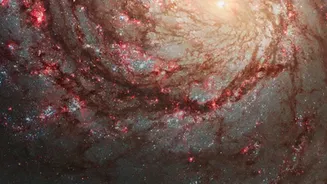
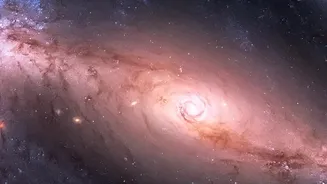
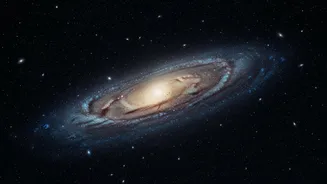
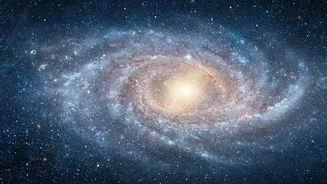
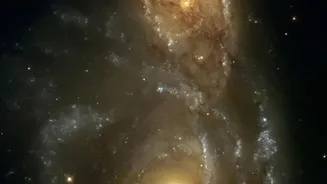
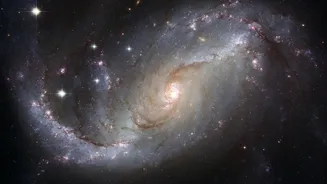
Beyond planet-hunting, AI is also helping to classify the universe's vast collection of galaxies. A machine learning model named Morpheus was developed to analyze images from the James Webb Space Telescope, pixel by pixel, to identify and categorize astronomical objects. Similarly, an AI tool named AnomalyMatch was used to scan nearly 100 million image cutouts from the Hubble archives, identifying over 1,300 odd objects, including galactic mergers and gravitational lenses, in just a couple of days. This process not only speeds up the tedious work of galaxy classification but also helps astronomers spot truly unique and bizarre objects that might otherwise go unnoticed, providing crucial data for understanding how galaxies evolve.
More Than Just an Algorithm
It's important to understand that these AI tools are not replacing human astronomers. Instead, they are powerful assistants that augment human capabilities. The AI handles the heavy lifting of data processing, freeing up scientists to focus on the more complex tasks of interpretation, verification, and follow-up observations. In many cases, the AI identifies candidates, but a human expert makes the final confirmation. Projects like Galaxy Zoo even combine AI with citizen science, where the public helps train and verify the classifications made by algorithms. This collaborative model, blending machine efficiency with human intellect and curiosity, represents the new frontier of astronomical research.