



A Universe We Thought We Knew
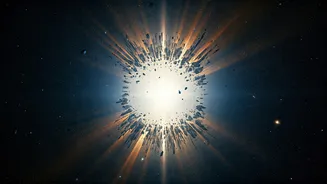
For decades, cosmologists have operated with a remarkably successful recipe for the universe, known as the Lambda-CDM model. It tells a grand story beginning with the Big Bang nearly 14 billion years ago. In this model, the cosmos is composed of ordinary
matter, mysterious dark matter, and an even more enigmatic dark energy driving cosmic expansion. The story of structure formation was thought to be a 'bottom-up' process: small clumps of dark matter gravitationally attracted gas, slowly forming the first stars and small galaxies, which then gradually merged over billions of years to create the grand, massive galaxy clusters we see in the universe today.
The Unexpected Ancients
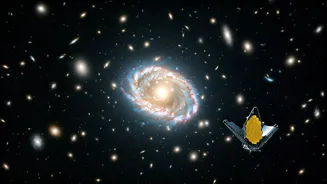
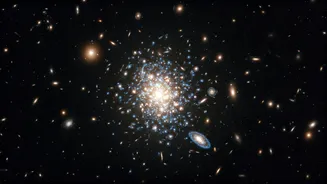
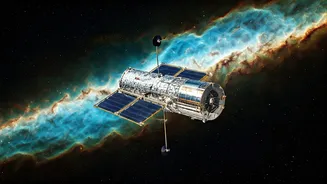
The James Webb Space Telescope (JWST), along with other powerful observatories, is peering deep into cosmic history and finding objects that challenge this orderly timeline. Recent studies have highlighted ancient galaxy clusters, or 'protoclusters', that are far more developed than our theories predict. One such cluster, designated XLSSC 122, is seen as it was just 3.4 billion years after the Big Bang, yet it appears surprisingly massive and concentrated, resembling clusters much closer to us in time. Another protocluster, JADES-ID1, was found assembling just one billion years after the Big Bang—one or two billion years earlier than expected for such a massive structure. These are not small, fledgling groups of stars; they are cosmic giants that appear to have grown up in a hurry.
A Wrinkle in Cosmic Time
The existence of these 'impossible' early structures creates a significant puzzle for astrophysicists. The Lambda-CDM model suggests that it takes a very long time to gather enough matter and energy to form such enormous clusters. Finding them in a mature state so early on is like finding a skyscraper in a village that was founded only yesterday. It suggests that the process of structure formation might have been much faster or followed a different path than we believed. For instance, the gas in one protocluster from the early universe was found to be at least five times hotter than theories predicted, a massive surprise that forces a rethink of how these large structures evolve. These discoveries suggest something is missing from our understanding of the early universe's physics.
Not the First Puzzle Piece
These ancient clusters are not the only things making cosmologists scratch their heads. They are part of a growing collection of observations creating 'tensions' with the standard model. For years, scientists have debated the 'Hubble Tension'—a disagreement on how fast the universe is expanding today depending on whether you measure it using early-universe data or local, more recent objects. The JWST has also found individual galaxies and supermassive black holes in the early universe that seem impossibly bright and large for their age. Each new anomaly, from these ancient clusters to 'little red dots' that might be a new type of object entirely, adds to the feeling that our cosmic map is incomplete.
What Happens Now?
This is not a crisis for cosmology, but an opportunity. When observations defy predictions, it’s a sign that a deeper understanding is within reach. Scientists are now working to determine if the standard model needs a few tweaks or a major overhaul. It may be that our theories about how quickly gas cools and forms stars are wrong, or that black holes play a much more dramatic role in accelerating galaxy growth than previously thought. The next step is to find more of these early structures and study them in greater detail. As one astronomer noted, seeing these protoclusters form is like watching an assembly line make a car, rather than just looking at the finished product. It's a fundamental glimpse into cosmic construction.