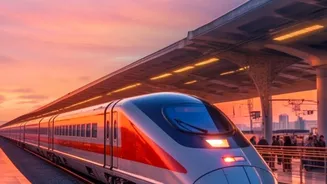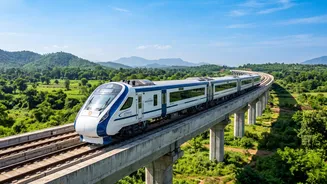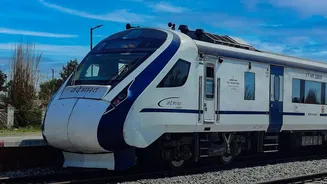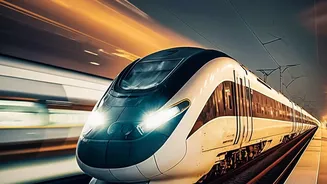





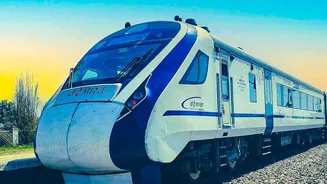
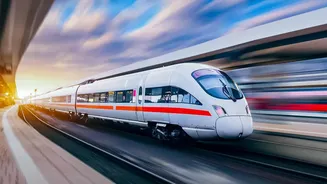
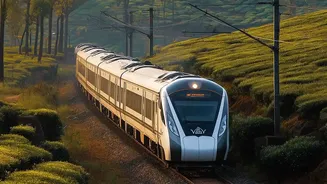
India's long-held dream of a bullet train is rapidly becoming a reality. The first passenger service on the ambitious Mumbai-Ahmedabad corridor is slated to begin in 2027, with the Surat-Vapi section in Gujarat leading the charge.
The First Stretch of a New Era
The initial focus of
India's high-speed rail debut will be the stretch connecting Surat and Vapi in Gujarat. According to Railway Minister Ashwini Vaishnaw, this section is targeted to become operational in the last quarter of 2027. This phased approach allows the National High Speed Rail Corporation (NHSRCL), the body executing the project, to launch services on completed portions while construction continues elsewhere. The decision to prioritise this section highlights the significant progress made in Gujarat, where land acquisition and civil construction have moved at a swift pace. Recently, a major technical milestone was achieved when the 50-km Surat-Bilimora portion of the track had its overhead electrical equipment 'energised', meaning the power was switched on, paving the way for future testing.
Engineering Marvels on the Ground
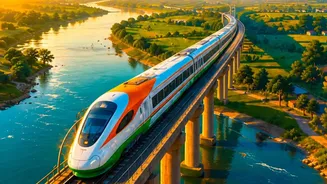
The entire Mumbai-Ahmedabad High-Speed Rail (MAHSR) corridor spans 508 kilometres and is a monumental engineering undertaking. As of late 2026, progress reports show that hundreds of kilometres of piers and viaducts—the elevated structures that will carry the tracks—are already in place. The project includes several firsts for India, most notably a 21-km tunnel in Maharashtra, 7 km of which will run under the sea at Thane Creek. To excavate this undersea tunnel, massive Tunnel Boring Machines (TBMs), each as tall as a four-storey building, were launched in July 2026. The corridor will feature 12 stations in total, connecting the key economic hubs of Mumbai, Surat, Vadodara, and Ahmedabad.
The Technology Behind the Speed
The corridor is being built with technical and financial assistance from Japan, utilising its world-renowned Shinkansen technology. Trains are designed to operate at a speed of 320 km/h, which will drastically cut travel time. The journey between Mumbai and Ahmedabad, which currently takes several hours by road or conventional rail, is expected to be completed in just under two hours once the entire line is functional. A sophisticated 2x25 kV overhead traction system, common in high-speed railways globally, will power the trains, drawing electricity from the national grid via 14 substations along the route.
A 'Made in India' Bullet Train
While the project leverages Japanese technology for its infrastructure, a significant push for indigenous manufacturing is also underway. The first trainsets to run on the tracks will be Made in India. The B28 trainset, being manufactured by ICF and BEML, is designed for speeds up to 280 km/h. The first body frame has already been completed and is undergoing structural tests, with track trials anticipated by mid-2027. This move not only fast-tracks the operational timeline but also marks a crucial step in developing domestic high-speed rail manufacturing capabilities. A faster, next-generation B35 train designed for 350 km/h is also in the pipeline.
What's Next for the Project?
Following the launch of the Surat-Vapi section, the rest of the corridor will open in phases as construction completes. Trial runs on the Surat-Bilimora stretch are expected to begin around May 2027, a critical step before passenger services can be certified as safe. The complete Mumbai-Ahmedabad line is aimed for completion by the end of 2029. The successful rollout of this first section is seen as a proof of concept that could catalyse the development of other proposed high-speed rail corridors across India, fundamentally transforming the nation's transport landscape and creating new economic linkages between its major cities.