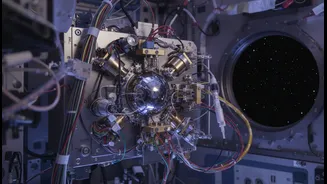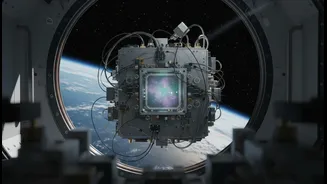







What Is the Cold Atom Lab?
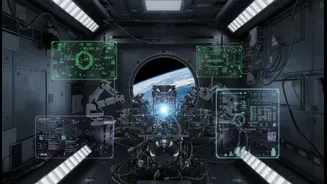
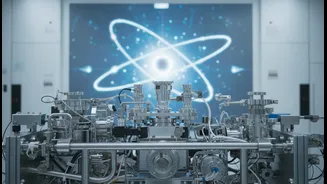
Launched in 2018, the Cold Atom Lab (CAL) is a sophisticated physics instrument aboard the International Space Station. Operated remotely from Earth, it's designed to perform experiments that are impossible to do on the ground. Its primary mission is to create
and study a bizarre state of matter called a Bose-Einstein Condensate (BEC), which only appears at temperatures fractions of a degree above absolute zero, the theoretical point where all atomic motion stops. By doing this in space, CAL opens a new window into the quantum world, where the familiar rules of physics give way to strange and wonderful phenomena.
Creating a Cosmic Deep Freeze
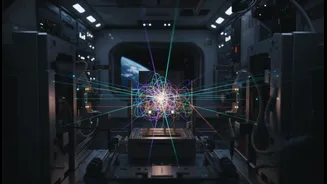
Creating a BEC is a multi-step process of chilling atoms. First, lasers are fired at a cloud of atoms, typically rubidium or potassium, from all directions. While it seems counterintuitive, hitting atoms with precisely tuned laser light slows them down, drastically reducing their temperature. Think of it as using photons to push back against the atoms' motion. Once the atoms are laser-cooled, a magnetic field traps them, and a process called 'evaporative cooling' kicks in. This technique removes the 'hottest' (most energetic) atoms from the trap, causing the remaining cloud to become even colder until it reaches the tipping point—just above absolute zero—and the atoms merge into a single quantum object, the BEC. In this state, thousands of individual atoms behave like one giant 'super-atom'.
Why Do This in Space?
The main reason for sending CAL to space is to escape a fundamental force: gravity. On Earth, gravity constantly pulls on atoms. This means scientists have to use powerful magnetic traps to hold the ultra-cold atom clouds in place, and even then, the BECs can only be observed for fractions of a second before they collapse or fall apart. In the microgravity environment of the ISS, atoms are in a state of continuous freefall. This allows scientists to use much weaker magnetic traps, or even no trap at all, letting the BECs expand and exist for much longer—up to ten seconds or more. This extended observation time is a game-changer, allowing for more precise measurements and the study of subtle quantum effects that are invisible on Earth.
The Promise of Precision Sensing
The orderly, slow-moving atoms in a BEC are incredibly sensitive to their surroundings, making them perfect for precision sensing. This technology, known as atom interferometry, uses the wave-like nature of atoms to measure tiny changes in forces like gravity and rotation. Potential applications are vast. They could lead to the development of ultra-precise atomic clocks, which are crucial for GPS and financial networks. They could also be used to build next-generation navigation systems for deep space missions that don't rely on external signals. On Earth, similar technology could be used to monitor groundwater reserves, detect underground volcanic activity, or explore for mineral resources by measuring minute variations in Earth's gravitational field.
Benefits, Limits, and the Future
The primary benefit of CAL is its role as a platform for fundamental physics research. It allows scientists to test core principles of quantum mechanics and general relativity, such as the equivalence principle, with unprecedented accuracy. However, the technology is still in its early stages. The current experiments are complex, and the equipment is highly specialized and confined to the ISS. A key limitation is that BECs are currently a laboratory phenomenon; creating them requires a highly controlled environment, making widespread practical application outside of high-tech sensing a distant goal. Yet, the insights gained are invaluable. As the technology matures, future versions of quantum sensors derived from this research could become standard tools, much like the laser went from a lab curiosity to a ubiquitous technology.