



The Cosmic Time-Twist
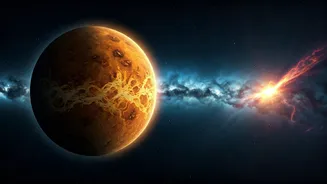
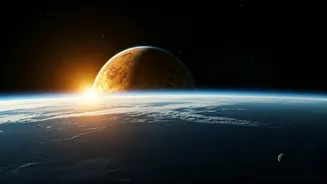
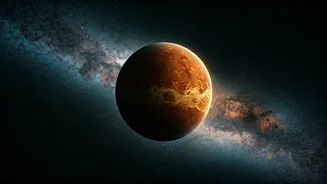
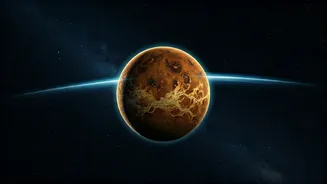
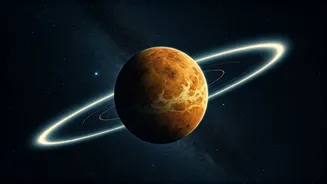
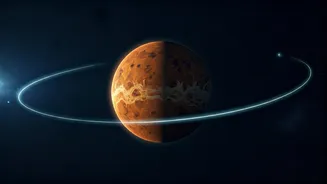
Let’s get the mind-bending numbers out of the way first. Venus takes approximately 225 Earth days to complete one orbit around the Sun. That’s its year. However, it takes a staggering 243 Earth days to complete a single rotation on its axis. This is what
astronomers call a 'sidereal day.' This means that a single spin of the planet takes 18 days longer than its entire journey around the Sun. On Earth, we are used to a year being made of 365 days. On Venus, a year is made of just 0.92 Venusian days. This is a unique and bizarre arrangement within our solar system, making Venus a true outlier.
A Day Isn't Just a Day
To make things even more confusing, the 'day' you would experience on Venus isn't actually 243 Earth days long. We need to distinguish between a sidereal day (one full 360-degree rotation) and a 'solar day' (the time from one sunrise to the next). Because Venus rotates backwards (more on that in a moment) while also orbiting the Sun, these two measurements are very different. The time from one sunrise to the next on Venus is 'only' about 117 Earth days. So, if you could somehow survive on the surface, you would experience roughly 58 days of continuous daylight followed by 58 days of continuous darkness. While this is shorter than the full rotation period, it’s still an incredibly long day-night cycle, unlike anything on Earth.
Spinning the Wrong Way
A huge part of this temporal puzzle is Venus's retrograde rotation. Almost every planet in our solar system, including Earth, spins counter-clockwise on its axis. But Venus spins clockwise. If you were on Venus, the Sun would appear to rise in the west and set in the east. This backward spin works against its orbit, which is what stretches the solar day to that 117-Earth-day figure. Why does it spin backwards? Scientists aren’t entirely sure, but the leading theory is that early in its history, Venus was struck by a massive planet-sized object. This cataclysmic impact could have been powerful enough to not just halt its original rotation but reverse it entirely, setting it on its strange path.
The Atmosphere as an Anchor
Another compelling theory, or perhaps a contributing factor, involves Venus's crushingly thick atmosphere. The atmosphere of Venus is 90 times denser than Earth's and is in a state of 'super-rotation,' whipping around the planet in just four Earth days. Scientists believe this powerful, heavy atmosphere creates a strong 'atmospheric tide' due to the Sun's gravity. Over billions of years, the friction between the fast-moving atmosphere and the solid planet below could have acted as a massive brake, slowing Venus's rotation to its current crawl. It’s possible that both a primordial impact and atmospheric braking worked together to create the planet we see today.
A Hellish and Unforgiving Clock
This slow, backward rotation contributes directly to Venus’s hellish environment. The planet is the hottest in our solar system, with surface temperatures averaging around 465° Celsius — hot enough to melt lead. One might assume that the long nights would offer some relief, but they don’t. The planet’s thick blanket of carbon dioxide clouds traps heat so effectively that there is almost no temperature variation between day and night, or between the equator and the poles. This runaway greenhouse effect makes the planet a uniform, unforgiving furnace, driven by a clock that seems to have been broken and reassembled in the most peculiar way imaginable.