

Piercing the Cosmic Veil
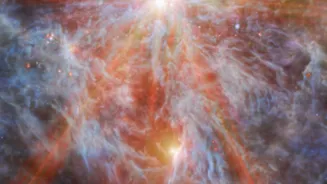
Imagine trying to see through a dense fog. That's the challenge astronomers face when studying star formation. Stars are born inside vast, thick clouds of cosmic gas and dust, often called stellar nurseries. This dust, made of tiny particles like silicates
and carbon, effectively blocks visible light, hiding the baby stars within. Infrared light, however, has a longer wavelength than visible light. This allows it to pass through the dense dust clouds much more easily, giving scientists a direct view of the processes leading to the birth of stars and planets. Webb's infrared instruments can peer inside iconic stellar nurseries like the Pillars of Creation, revealing complex star formation that was previously hidden from view. It's like having X-ray vision for the cosmos.
A Window to the Distant Past
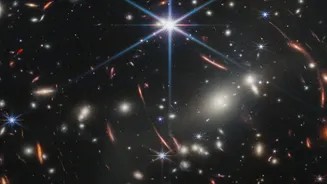
Seeing far away in space means looking back in time, because of the time it takes for light to travel across the cosmos. But there's another crucial factor: the expansion of the universe. Since the Big Bang, space itself has been stretching. As light from the earliest, most distant galaxies travels toward us, its waves get stretched along with the fabric of space. This phenomenon, called cosmological redshift, shifts the light to longer, redder wavelengths. Light that was originally emitted as visible or even ultraviolet light from the universe's first stars has been stretched so much over its 13-billion-year journey that it now arrives as infrared light. To witness the cosmic dawn and see the first galaxies light up the universe, we must look in the infrared spectrum.
What Webb Is Actually Finding
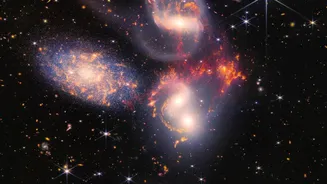
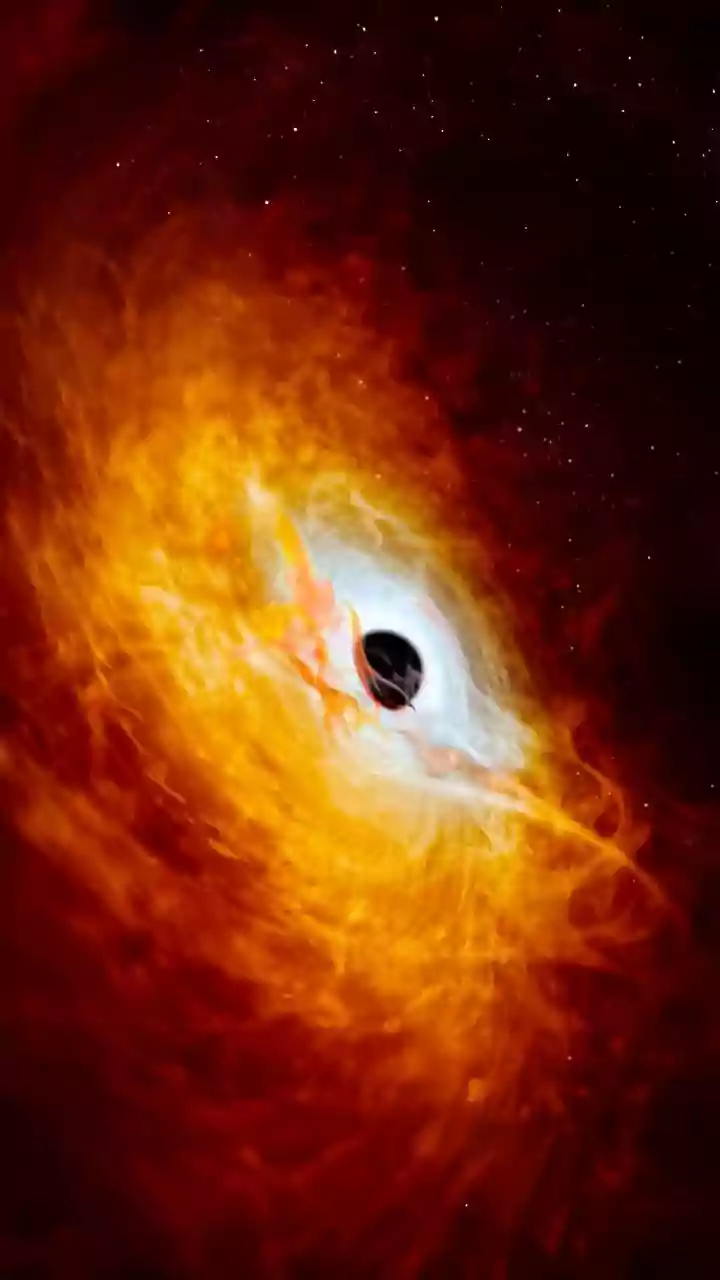
With its unique infrared capabilities, Webb is already revolutionizing our understanding of the early cosmos. Scientists using the telescope believe they may have spotted the universe's first generation of stars, known as Population III stars. These theoretical objects were forged from pure hydrogen and helium and are thought to be gargantuan, many times the mass of our sun. In another stunning discovery from August 2026, astronomers identified a bizarre new type of object dubbed a "black hole star." This mysterious, bright red dot from the early universe appears to be an enormous cloud of gas powered not by fusion, but by a massive black hole at its center. Webb is also finding that the first galaxies were often shaped like "surfboards and pool noodles" rather than the grand spirals we see today. It's also detecting complex molecules like water and ices in the clouds where stars form, offering clues about the raw materials for planets.
More Than Just a Picture
While Webb's images are breathtaking, much of its most important work comes from a technique called spectroscopy. Webb's instruments can split the incoming infrared light into its constituent wavelengths, like a prism creating a rainbow. This creates a spectrum, which acts like a chemical fingerprint. By analyzing the patterns in this spectrum, scientists can determine a distant object's temperature, chemical composition, and motion. This is how astronomers have been able to identify the signatures of potential Population III stars and determine that a recently discovered strange galaxy's gas shines brighter than its stars. Spectroscopy turns Webb from a simple camera into a powerful physical analysis tool, allowing us to understand not just what early stars looked like, but what they were made of and how they behaved.