






Meet the 'Warm Neptunes'
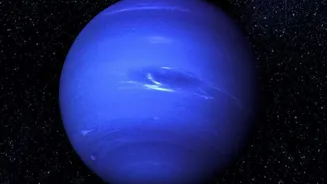
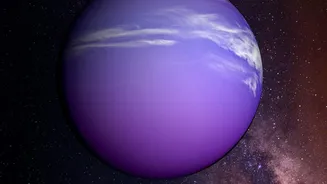
Imagine a planet roughly the size of Neptune or Uranus from our own solar system. Now, move it much closer to its parent star, placing it in an orbit where temperatures are far toastier than our own ice giants could ever withstand. This is a 'Warm Neptune.'
These exoplanets are a class of gas giant that orbits its star closer than 1 AU (the distance from the Earth to the Sun), making them much hotter than the distant, icy Neptunes we know. They are mostly composed of hydrogen and helium and are a relatively common type of planet found in our galaxy, though none exist in our solar system. This makes them a fascinating puzzle; they challenge our neat categories and force us to consider planetary formation scenarios different from our own neighborhood.
The Methane Mystery
For years, astronomers have been hunting for methane in the atmospheres of these distant worlds. In planets with temperatures below about 1,000 Kelvin (around 725 degrees Celsius), basic chemistry predicts that carbon should predominantly exist as methane (CH4). Yet, observations repeatedly came up empty, showing a mysterious lack of the molecule where it was expected to be abundant. This 'methane depletion' suggested that something was happening in the atmospheres of these planets that our models didn't account for. Theories ranged from the methane being photochemically destroyed by starlight to it being altered by intense heat and mixing processes from deep within the planet's scorching interior. The absence of methane was a significant roadblock to understanding their atmospheric chemistry.
A Breakthrough with the Webb Telescope
The game changed with the powerful infrared vision of the James Webb Space Telescope (JWST). In recent observations of a Warm Neptune named WASP-107b, scientists made a definitive detection of methane. Located about 437 light-years away, WASP-107b is a particularly fluffy, low-density planet, making its atmosphere a prime target for study. The JWST's instruments were sensitive enough to pick up the faint spectral signature of methane, which had eluded previous telescopes. While the amount detected was tiny—about 1,000 times less than what simple equilibrium models predicted—finding it at all was a massive breakthrough. It confirmed that methane does exist in these environments, but its low quantity pointed toward a very active and dynamic atmosphere.
Rewriting the Planetary Playbook
This discovery does more than just add a checkmark to a list of chemicals. The specific amount of methane found on WASP-107b allows scientists to test their complex atmospheric models with real data. The findings suggest the planet has a very hot interior and experiences vigorous vertical mixing—essentially, powerful updrafts that dredge material from the hot, deep layers to the cooler, upper atmosphere. This intense mixing process is believed to be what disrupts the expected chemical balance and depletes the methane. Furthermore, the data from WASP-107b enabled researchers to calculate a much higher core mass for the planet than previously estimated, resolving a long-standing tension with theories of how such planets form. It suggests the planet formed through a process called core accretion, just like the giants in our solar system, but under very different conditions.