

Seeing the Invisible Universe
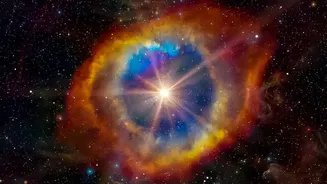
When we look at the night sky, we see visible light—the tiny fraction of the electromagnetic spectrum our eyes are built to detect. But stars, planets, and galaxies emit light across a much wider range. Infrared light, which we feel as heat, is one such
type of invisible light. While our eyes can't see it, specialised telescopes can. This is the foundation of infrared astronomy, a technique that allows us to perceive a universe that would otherwise remain hidden, revealing the heat signatures of everything from cool, dim stars to the faint glow of the earliest galaxies.
Piercing Through Cosmic Dust
One of infrared astronomy’s greatest strengths is its ability to see through the dense clouds of gas and dust that drift through space. Visible light, with its shorter wavelengths, gets scattered and blocked by these cosmic clouds, much like headlights in a thick fog. This means that crucial cosmic events, such as the birth of new stars and planets inside these stellar nurseries, are completely hidden from traditional telescopes. Infrared light, however, has longer wavelengths that can pass through the dust unhindered. This gives astronomers a direct window into the cradles of creation, allowing them to watch as new solar systems form within clouds that once appeared as dark, empty patches in the sky.
A Machine for Looking Back in Time
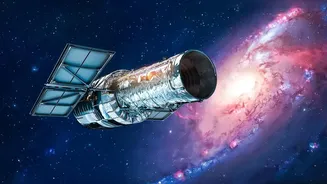
Because light travels at a finite speed, looking at distant objects is equivalent to looking back in time. The James Webb Space Telescope (JWST), a marvel of infrared astronomy, is essentially a time machine. The universe is constantly expanding, and as it expands, the light from the most ancient galaxies is stretched. This process, known as 'redshift', shifts the light from the visible and ultraviolet spectrum into the infrared. To see the very first stars and galaxies that formed just a few hundred million years after the Big Bang, we must look for this redshifted infrared light. The JWST is specifically designed to capture this faint, ancient glow, providing unprecedented views of the cosmic dawn.
A Hidden Planet Revealed
The power of this technology was recently demonstrated with a stunning discovery. In mid-July 2026, astronomers using the JWST announced they had found a new giant planet, Beta Pictoris d, orbiting a famous nearby star. This system was already one of the most intensely studied in our galaxy, yet the planet remained hidden within a bright, messy disk of cosmic dust. Traditional imaging methods were blinded by the glare. However, by using an infrared spectrograph, the JWST team wasn't looking for a point of light but for a chemical signature. They found the tell-tale signs of methane and water vapour in a place they didn't expect, revealing the atmosphere of a planet they didn't know was there. This technique proved decisive, showing how infrared can find worlds that are otherwise impossible to see.
The Future Is Infrared
The discovery of Beta Pictoris d is just the latest in a string of breakthroughs powered by infrared astronomy. From analyzing the atmospheres of potentially habitable exoplanets to discovering the mysterious 'Little Red Dots' that may be the seeds of the first supermassive black holes, this technology is at the forefront of answering our biggest questions. As observatories like the JWST continue their work and future missions like NASA's Roman Space Telescope prepare to launch with similar infrared capabilities, we are entering a golden age of discovery. Each new image and dataset pushes the boundaries of our knowledge, showing us that to truly understand the universe, we first have to learn how to see it.