






The Core Strength Question
Both sports are celebrated for their core-strengthening benefits, but they achieve it differently. Stand-up paddleboarding is an exercise in continuous stability. To stay upright, your deep core muscles, including your abs, obliques, and lower back, are constantly
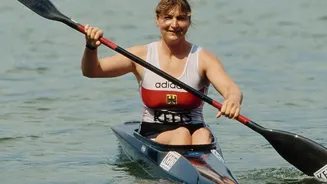
engaged to maintain balance. Every ripple on the water forces micro-adjustments, turning your core into a primary stabiliser. Kayaking, on the other hand, builds core strength through rotational power. With each stroke of the double-bladed paddle, you twist your torso, engaging your obliques and abdominal muscles powerfully. While paddleboarding focuses on constant, low-level core engagement for balance, kayaking targets the core with dynamic, powerful twisting motions.
Upper Body Power And Endurance
If your goal is building significant upper body strength, kayaking holds a distinct advantage. The repetitive motion of pulling a double-bladed paddle through the water provides a focused workout for the back (lats), shoulders (deltoids), and arms (biceps and triceps). It’s a powerful combination of cardio and resistance training that builds both strength and endurance in the upper body. Paddleboarding also works the upper body, but the engagement is different. Using a single, longer paddle requires a more vertical pulling motion that engages the shoulders and arms, but often less intensely than kayaking. The primary challenge in SUP remains balance, making the upper body workout a secondary, though still important, component.
Lower Body And Full-Body Integration
This is where stand-up paddleboarding truly shines. To balance on the board, your legs and glutes are in a constant state of isometric contraction, similar to holding a slight squat for the entire session. This continuous engagement tones the lower body and builds stabilizer muscles in your hips, knees, and ankles. Kayaking is a seated activity, so lower body involvement is less obvious but still present. Your legs and hips are used to brace against the kayak for stability and to help power the rotation of your torso, but it does not provide the same level of toning or strength-building as paddleboarding. Because it constantly engages the legs and core for balance while the upper body works to paddle, SUP is often considered a more complete full-body workout.
Calorie Burn and Cardiovascular Fitness
The number of calories burned in either sport depends heavily on intensity, duration, and water conditions. However, paddleboarding generally has a slight edge in potential calorie burn because it engages more muscle groups simultaneously to maintain balance. On average, recreational paddleboarding can burn between 400 and 700 calories per hour, while kayaking typically burns between 300 and 500. Both activities are excellent for cardiovascular health, elevating your heart rate and improving endurance. Kayaking can sometimes lead to a more vigorous cardio session due to the continuous, powerful paddling motion required to cover distances.
Making Your Choice
Choosing between kayaking and paddleboarding depends entirely on your specific strength goals. If you want a workout that delivers an intense upper body and rotational core workout, kayaking is an excellent choice. It’s ideal for building power in your back, shoulders, and arms. If you are looking for a true full-body workout that challenges your balance, strengthens your deep core stabilizers, and tones your legs while also working your upper body, stand-up paddleboarding is likely the better fit. It provides a unique blend of strength, balance, and endurance. For beginners, kayaking is often considered easier to learn initially due to the stable, seated position, whereas paddleboarding presents the immediate challenge of learning to balance.