




Atop a mountain in Chile, the Vera C. Rubin Observatory is preparing to create the most detailed map of the universe ever made. But a new technological ambition—placing massive data centres in orbit—is casting a long shadow over its mission.
A New Eye on the Cosmos
The Vera C.
Rubin Observatory is not just another telescope; it's a revolutionary instrument designed for a decade-long project called the Legacy Survey of Space and Time (LSST). Its goal is monumental: to photograph the entire visible southern sky every few nights. This rapid, wide-field survey will generate a treasure trove of data, enabling scientists to tackle some of the biggest mysteries in astrophysics. By observing how the cosmos changes over time, astronomers hope to map the distribution of dark matter, chart the expansion driven by dark energy, discover potentially hazardous asteroids, and catalogue billions of new stars and galaxies. The observatory's strength lies in its ability to detect faint and transient objects, things that flash, move, or change in the night sky. This sensitivity makes it uniquely powerful, but also exquisitely vulnerable to a new and growing threat in low-Earth orbit.
The Cloud Moves to Orbit
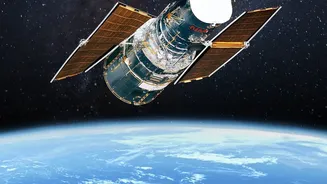
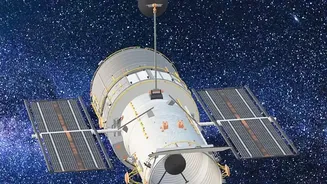
While astronomers look out, the tech industry is looking up with a different goal. The concept of a 'megaconstellation'—a network of thousands of satellites working in concert—is already a reality with services like SpaceX's Starlink providing global internet. But the next evolution is the 'orbital data centre' (ODC). Recent proposals describe plans to launch hundreds of thousands, or even over a million, satellites that function as data processing and storage hubs in space. The idea is to create a global, low-latency cloud computing infrastructure powered by artificial intelligence, accessible from anywhere on the planet. These are not the small satellites currently in orbit. Proposed designs involve enormous, kilometre-scale solar panels to power the onboard computing, making them vastly larger and more reflective than anything launched to date.
A Sky Full of Streaks
The alarm bells ringing at the Rubin Observatory, and throughout the astronomical community, are about light pollution on an unprecedented scale. Satellites don't produce their own light, but their metallic surfaces and vast solar arrays reflect sunlight back towards Earth, making them appear as bright, moving stars. For a telescope taking long exposures of faint galaxies, a single satellite passing through its field of view leaves a bright white streak across the image, completely obscuring the scientific data behind it. Studies and simulations focused on the Rubin Observatory predict that with the proposed megaconstellations, a significant percentage of its images—up to 30% or even higher on some nights—could be contaminated. The sheer number of proposed satellites means that avoiding them would be practically impossible for a wide-survey instrument like Rubin. The issue is most severe during twilight hours, precisely when observatories conduct crucial searches for near-Earth asteroids.
More Than Just Pretty Pictures
The problem extends beyond ugly streaks. A sky crowded with satellites, even ones too faint to be seen individually, contributes to an overall increase in the diffuse background brightness of the night sky. This 'sky glow' acts like a permanent layer of haze, reducing the contrast and making it harder to detect the faintest and most distant objects in the universe—the very targets Rubin was built to study. The proposed ODCs, being tens of thousands of times brighter than current satellites, could dramatically worsen this effect, with some analyses suggesting they could increase sky brightness near twilight by over 1000%. This light pollution not only threatens groundbreaking science but also elevates the risk of space debris and cascading collisions, a scenario known as the 'Kessler syndrome'.
Can the Stars and Satellites Coexist?
The conflict has spurred a difficult conversation between astronomers and satellite operators. Mitigation efforts are underway, including developing software to identify and mask satellite trails in images and encouraging companies to use anti-reflective coatings and design satellites that are inherently less bright. However, these measures are only partially effective. Removing a bright streak can still leave behind residual artifacts that corrupt sensitive scientific analysis, and there are currently no binding international regulations on satellite brightness. Astronomers are urging for a cap on the number of satellites, keeping them in lower orbits to reduce their time in sunlight, and orienting solar panels to avoid reflecting light towards Earth. Without robust regulation and proactive collaboration, scientists warn that we risk trading our view of the cosmos for a different kind of global network, potentially losing the ability to answer fundamental questions about our place in the universe.