




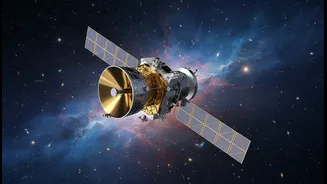


A New Cosmic Surveyor
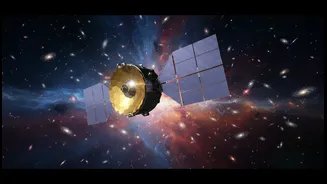
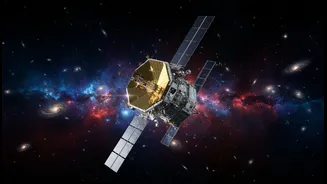
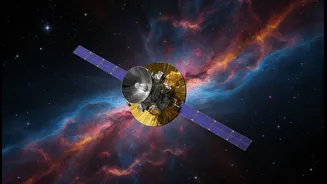
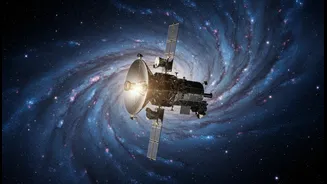
Set to launch in the coming months, the Nancy Grace Roman Space Telescope is NASA's next flagship observatory. Named after the agency's first chief of astronomy, Nancy Grace Roman, often called the “Mother of Hubble,” this mission promises to expand on the legacies
of Hubble and the James Webb Space Telescope. Its primary goals are ambitious: to unravel the mysteries of dark energy and dark matter, and to discover thousands of new exoplanets using a technique called gravitational microlensing. What sets Roman apart is its incredible field of view. While Hubble and Webb take breathtaking but narrow snapshots of the universe, Roman is designed for sweeping panoramic surveys. It can capture an area of the sky 100 times larger than Hubble in a single observation, allowing it to map vast regions of the cosmos with unprecedented speed and efficiency.
The Challenge of Building a Flagship
Creating a machine like the Roman Telescope is a monumental undertaking. The journey from its initial recommendation in the 2010 Decadal Survey to its current state as a fully integrated spacecraft has been a long and complex one. With a 2.4-meter primary mirror—the same size as Hubble's but with a much wider view—and two powerful instruments, the Wide Field Instrument and a technology-demonstrating Coronagraph, the mission represents the pinnacle of astronomical engineering. However, like most projects of this scale, its development has faced significant hurdles. The mission's cost has grown to an estimated $4.3 billion, an increase partially attributed to disruptions from the COVID-19 pandemic. It has also navigated budgetary challenges and proposals for cancellation, demonstrating the precarious path that large-scale scientific projects must often tread.
The Launch Plan Predicament
A critical, and often complex, part of any space mission is the launch. Traditionally, major NASA missions have been designed with a specific launch vehicle in mind. This integration is logical—the spacecraft must be designed to withstand the forces of its specific ride to orbit and fit within its payload fairing. However, this approach can lock a multi-billion-dollar project into a dependency on a single rocket, years in advance. If that rocket program faces delays, cost overruns, or is even cancelled, the science mission can be left in limbo. The Roman telescope's launch was awarded to SpaceX for its Falcon Heavy rocket in 2022, a decision made relatively late in its development. This situation highlights a growing discussion within the space industry: should the development of the spacecraft be decoupled from the choice of launch vehicle for as long as possible?
The Case for Decoupling
The argument for separating spacecraft design from launch selection is rooted in flexibility and cost-effectiveness. In the current era, the launch market is more dynamic than ever before. The rise of commercial providers like SpaceX has introduced powerful, reliable, and often cheaper options. By not committing to a specific launcher early on, NASA can foster competition, potentially driving down costs significantly, as seen with the $255 million contract for Roman's launch on the Falcon Heavy. Decoupling allows mission planners to select the best-value launch service closer to the actual launch date, taking advantage of the latest market offerings. It also insulates a long-term science project from the risks associated with a single launch vehicle's development schedule. This approach treats the launch as a service to be procured, rather than an integral, unchangeable part of the initial design from day one.
A New Model for Mission Success
The experience with the Roman Space Telescope serves as a powerful case study for this new model. While the mission is now on track for a launch that is impressively ahead of its revised schedule, its journey underscores the strategic advantages of launch flexibility. As NASA plans even more ambitious future observatories, like the proposed Habitable Worlds Observatory, the lessons from Roman will be critical. Adopting a strategy that formally separates the design and construction of the scientific payload from the procurement of the launch service could streamline development, reduce costs, and mitigate risks. It represents a shift in thinking—from building a single, monolithic system to integrating two distinct components: the scientific instrument and the transport that takes it to its workplace in the cosmos. This business-minded approach could be the key to ensuring the next generation of great observatories makes it off the drawing board and into space.