



A Telescope on a Global Scale
The Square Kilometre Array isn't a single telescope but a globe-spanning network of thousands of antennas, working together as one gigantic observatory. Led by the SKA Observatory (SKAO), an intergovernmental organisation with its headquarters in the UK,
the project is being constructed in two primary locations. These sites were chosen for their remote, radio-quiet environments, far from the interference of modern life. The SKA is being built in two phases, with the first phase, known as SKA1, well underway and expected to begin scientific operations around 2027. Construction officially started in December 2022. The name itself hints at its incredible ambition: to create a telescope with a total collecting area of one square kilometre.
Two Continents, Two Telescopes
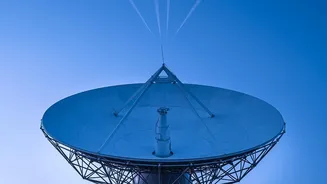
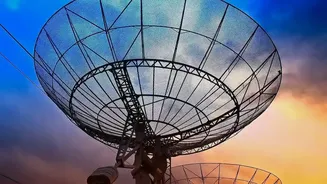
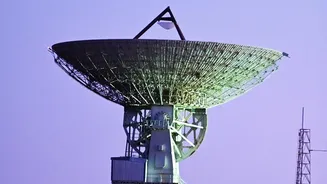
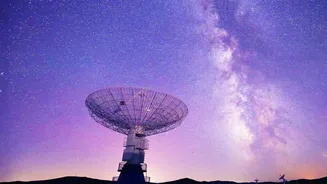
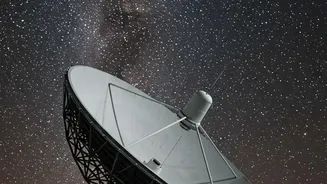
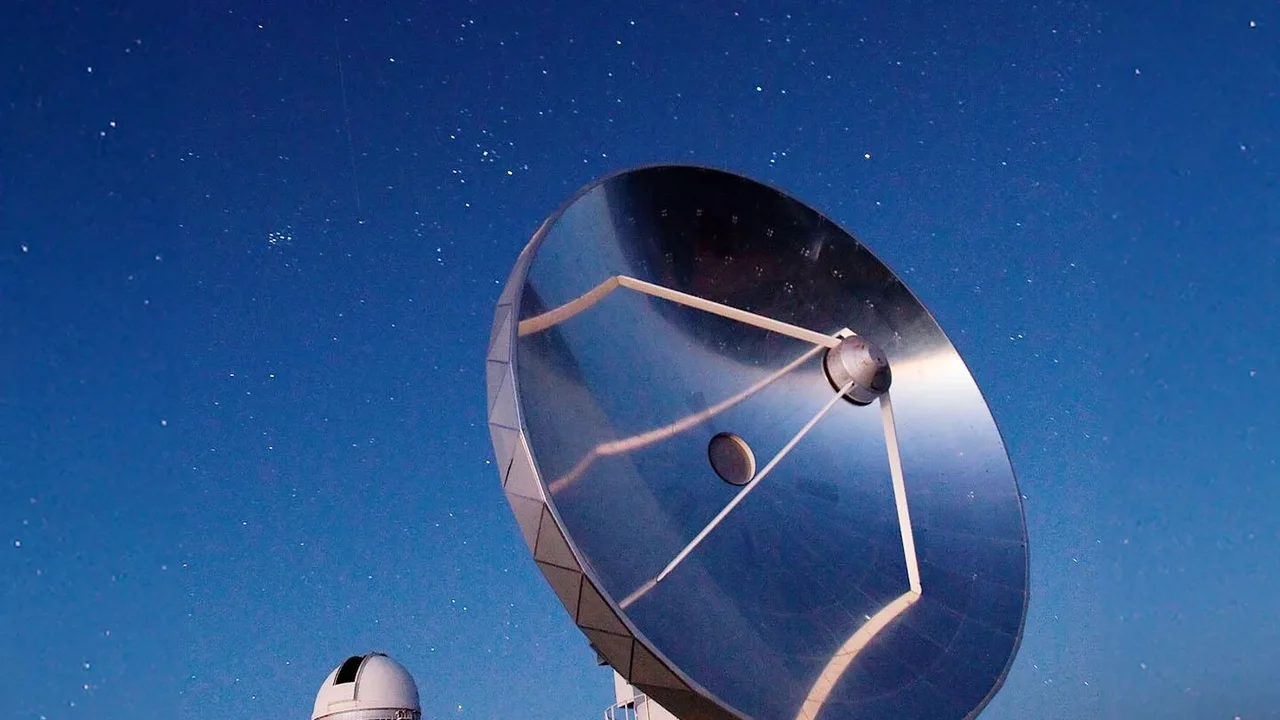
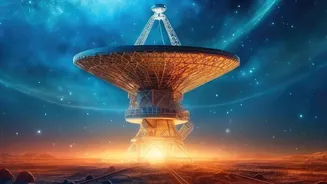
The SKA operates as two distinct but complementary instruments. In the Karoo region of South Africa, SKA-Mid will consist of nearly 200 traditional dish antennas, including the 64 existing MeerKAT dishes. These 15-metre dishes will scan the sky for mid-frequency radio waves. Meanwhile, in Western Australia, on the traditional lands of the Wajarri Yamaji people, SKA-Low is an array of over 131,000 small, tree-like antennas designed to capture low-frequency signals. By combining the signals from these thousands of individual antennas using a technique called interferometry, astronomers can simulate a single, gigantic telescope with unprecedented sensitivity and resolution. The antennas are spread out over vast distances—up to 150 km in South Africa and 74 km in Australia—to achieve incredibly detailed images.
Tuning into the Cosmic Dawn
One of the SKA's primary missions is to peer back to a mysterious period known as the Cosmic Dawn and the subsequent Epoch of Reionisation. This era, which occurred in the first billion years after the Big Bang, is when the very first stars and galaxies ignited, ending the cosmic 'dark ages'. Before these first stars, the universe was filled with a fog of neutral hydrogen gas. As the first stars and galaxies formed, their intense radiation began to ionise this gas, creating bubbles of cleared space that eventually grew to encompass the entire universe. The SKA is designed to detect the faint radio signal emitted by this primordial hydrogen, known as the 21-cm line. By mapping this signal, astronomers can create a 3D picture of how the universe lit up, watching the first structures emerge from the darkness.
How the Listening Works
The signals from the early universe are incredibly faint and have been stretched to longer, lower-frequency wavelengths by the expansion of the universe over 13 billion years. The SKA-Low telescope in Australia is specifically tuned to detect these faint, redshifted signals. The sheer number of antennas gives it a massive collecting area, making it 50 times more sensitive than any previous radio instrument. The signals collected by each antenna are digitised and sent via fibre optic cables to a central supercomputer. This 'brain', called the Central Signal Processor, correlates the immense data streams to create detailed maps of the sky. The data challenge is enormous, requiring processing power far beyond typical supercomputers.
Beyond the First Stars
While understanding the early universe is a key goal, the SKA's capabilities will transform many areas of astronomy. Scientists will use it to test Einstein's theories of gravity with extreme precision by timing signals from pulsars, which are rapidly rotating neutron stars. The observatory will also survey millions of galaxies to map the large-scale structure of the universe, helping to shed light on the mysterious forces of dark energy and dark matter. Furthermore, its sensitivity opens up new possibilities in the search for extraterrestrial intelligence (SETI), potentially detecting 'leakage' radiation from technologically advanced civilisations on nearby exoplanets. It could even detect complex organic molecules—the building blocks of life—in space.