



Gravity: The Universe’s Master Sculptor
The primary reason planets are round is gravity. A planet forms as material clumps together, growing more massive over time. Once an object reaches a certain size, its own gravity becomes powerful enough to pull all its material inward equally from all directions.
Think of it like the spokes of a bicycle wheel, all pulling toward the center hub. This relentless, uniform pull crushes any major irregularities, moulding the object into a sphere—the most stable and compact shape. This is why massive bodies like the Sun and the major planets are round. However, for smaller objects like asteroids and comets, their gravity is too weak to overcome their own structural strength. As a result, they can retain all sorts of irregular, lumpy forms, from potato-shaped moons to the rubber-duck shape of Comet 67P.
The Equatorial Bulge: A Tale of Speed
While gravity tries to make a perfect sphere, a planet's spin works against it. As a planet rotates, the material at its equator has to travel much faster than the material at its poles to complete a full circle in the same amount of time. This creates an outward-flinging motion, similar to the feeling of being pushed to the side on a fast-spinning merry-go-round. This force causes the planet to bulge out around its middle. The result is not a perfect sphere but an “oblate spheroid”—a slightly squashed ball that is wider at the equator than it is from pole to pole. Even Earth has this bulge; our planet's diameter is about 42 kilometres wider at the equator. While that’s a tiny difference of only 0.3%, it’s a crucial clue about our world.
Reading the Speed and Substance
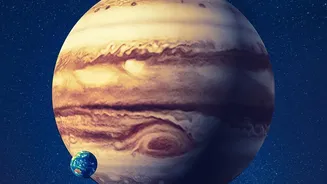
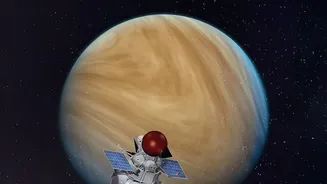
The size of this equatorial bulge is incredibly revealing. It tells astronomers about a planet's rotation speed and what it’s made of. Gas giants like Jupiter and Saturn spin incredibly fast and are mostly composed of fluid gases and liquids, which are easily reshaped. Consequently, they have very pronounced bulges. Saturn, the flattest planet in our solar system, is nearly 11% wider at its equator than at its poles. In contrast, rocky planets with slow rotations are far more spherical. Venus and Mercury, which spin very slowly, are almost perfect spheres. By measuring this oblateness, scientists can model a planet's rotational period and gain insights into its internal structure—whether it has a solid core, a liquid mantle, or a deep, gassy atmosphere.
How We Measure from Millions of Miles Away
Determining a planet's precise shape from such vast distances is a triumph of scientific ingenuity. For planets in our solar system, astronomers can use powerful telescopes to measure their angular size and send space probes to map them with radar. But for more distant worlds, the methods are even more clever. A planet’s imperfect shape creates slight irregularities in its gravitational field. Scientists can measure these variations by observing how the planet tugs on its moons or on orbiting spacecraft. These tiny gravitational anomalies allow them to build a detailed map of the planet's shape and mass distribution. For exoplanets orbiting distant stars, astronomers use the transit method. When a planet passes in front of its star, it blocks a small amount of light. The depth of this dimming reveals the planet's size. In some rare cases, like the exoplanet WASP-103b, the tidal forces from its star are so extreme that they stretch the planet into a football-like shape, a distortion that can also be detected in the transit data.