



The Scale of the Oxygen Problem
Before we can establish a permanent base on Mars, we need a reliable, long-term source of breathable air. More pressingly, we need an enormous amount of oxygen to use as a rocket propellant for the return journey. To launch four astronauts from the Martian
surface, it’s estimated they would need about 25 metric tons of oxygen, combined with 7 metric tons of fuel. For comparison, the crew would only need about one metric ton of oxygen to breathe for an entire year. Transporting 25 tons of oxygen from Earth is an immense logistical challenge; it is incredibly expensive and would require hundreds of tons of material to be launched into Earth's orbit just to get it there. The only practical solution is to “live off the land,” a concept known as In-Situ Resource Utilization (ISRU), by making oxygen from materials already on Mars.
A Golden Box: The MOXIE Experiment
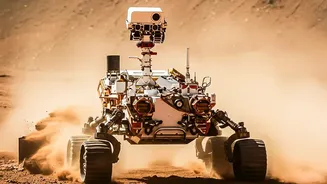
The leading technology in this field has already been proven on the Martian surface. Aboard NASA's Perseverance rover is a small, toaster-sized instrument called the Mars Oxygen In-Situ Resource Utilization Experiment, or MOXIE. This remarkable device is essentially a reverse fuel cell. It pulls in the thin Martian atmosphere, filters it, compresses it, and then heats it to a blistering 800 degrees Celsius. Using a process called solid oxide electrolysis, it splits the carbon dioxide (CO2) molecules into oxygen ions and carbon monoxide. The oxygen ions are then combined to form pure, breathable oxygen (O2), while the carbon monoxide is harmlessly vented back into the atmosphere. Over 16 successful runs, MOXIE proved it could reliably produce about 6 to 12 grams of oxygen per hour—roughly the output of a large tree on Earth.
Beyond the Atmosphere: Mining for Water and Dirt
While MOXIE uses the atmosphere, scientists are exploring other rich sources of oxygen on Mars: water ice and soil. Mars has significant deposits of water ice, particularly at its poles. By mining this ice, future colonists could use electrolysis to split water molecules (H2O) into hydrogen and oxygen. This not only provides breathable air but also hydrogen, a key component for rocket fuel. The challenge here is the extensive mining operation required to access and process the ice. An even more abundant resource is the Martian soil, or regolith. The soil is about 45% oxygen by mass, locked away in minerals. New technologies, such as carbothermal reduction, aim to heat the regolith to high temperatures to release this oxygen. One prototype, the Carbothermal Reduction Demonstration (CaRD), uses concentrated solar energy to power this process, offering a path to extract vast amounts of oxygen from the very ground astronauts will walk on.
The Road Ahead: Scaling Up for Humanity
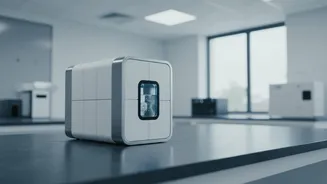
MOXIE was a groundbreaking proof-of-concept, but it’s a small-scale demonstrator. The next step is to engineer a much larger and more robust system. A future, scaled-up version of MOXIE would need to be about the size of a small freezer and work continuously for thousands of hours to produce the 25 tons of oxygen needed for a return trip. This system would need to be hundreds of times larger than the current instrument and require a significant power source, likely a dedicated solar farm or a small nuclear reactor. Scientists are also exploring alternative methods like plasma technology, which could potentially convert CO2 into oxygen more efficiently than MOXIE. Ultimately, a future Martian colony will likely employ a mix of these technologies—pulling oxygen from the air, ice, and soil—to create a resilient and self-sufficient life-support system.