





The Foundation: Vary Your Lengths
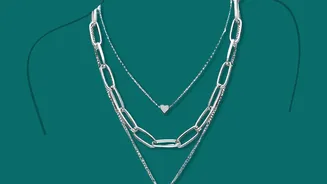
The most crucial rule for successful layering is to vary the lengths of your necklaces. This creates separation and allows each piece to be seen. A common strategy is to start with a choker or short chain (around 14-16 inches) that sits close to the neck.
Add a second, mid-length piece (around 18-20 inches) that rests on the collarbone. Finally, a longer necklace (22 inches or more) can complete the look by drawing the eye downward. Aim for at least a one- to two-inch gap between each layer to prevent them from bunching up and tangling. This simple principle is the bedrock of any great necklace stack.
Mix Textures and Weights
Combining different chain styles is a stylist's secret to creating visual interest and preventing tangles. When similar fine chains are layered together, they are more likely to twist into a knot. By mixing textures, you create natural separation. Try pairing a smooth, flat snake chain with a beaded necklace, or a delicate cable chain with a chunkier paperclip or rope style. The contrast not only looks intentional and sophisticated, but it also helps keep the individual chains from catching on each other. Furthermore, incorporating a heavier pendant on one of the chains can act as an anchor, weighing it down and helping all the layers stay in place.
Choose a Focal Point
While layering involves multiple pieces, it helps to have one hero item that acts as the focal point. This could be your favorite pendant, a meaningful charm, a locket, or a necklace with a unique texture. Build the rest of your stack around this main piece. If your focal point is a mid-length pendant, keep the other layers simpler to support and frame it rather than compete with it. If you're wearing a bold statement necklace, it should be the undeniable star, with the other, daintier chains serving as its supporting cast. This approach ensures your layered look feels curated and cohesive, not chaotic.
Break the Rules: Mix Your Metals
The old-fashioned rule of sticking to one metal color is officially outdated. Mixing gold, silver, and rose gold is a modern way to add an edgy, personalized feel to your jewelry. The key to making it look intentional is to find a sense of balance. A simple way to start is the 70/30 rule: let one metal be dominant, making up about 70% of your look, while the other serves as an accent. Another technique is to use a 'bridge' piece—a necklace that incorporates two tones—to tie everything together. You can also create a 'sandwich' effect, with a gold choker and a long gold pendant layered with a silver chain in the middle. Repeating each metal at least twice ensures the mix feels purposeful.
The Ultimate Hack for Tangle-Free Layers
Even with perfect spacing, delicate chains can sometimes find a way to tangle. A game-changing tool is a necklace layering clasp or separator. This small device has multiple rings to attach each of your necklaces to a single, neat clasp at the back of your neck. It keeps the chains perfectly spaced and prevents them from twisting over each other throughout the day. Another clever hack involves connecting your necklaces to each other to form one long chain. Clasp the end of the first necklace to the start of the second, and so on. Then, wrap the super-long chain around your neck multiple times and connect the two free ends. Adjust the loops to create your desired layered effect.