



A Celestial Illusion
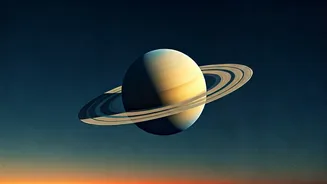
From Earth, Saturn's rings look like smooth, continuous discs, a cosmic vinyl record spinning in space. For centuries, this is how we saw them. But thanks to robotic explorers like the Voyager and Cassini spacecraft, we know the truth is far more complex
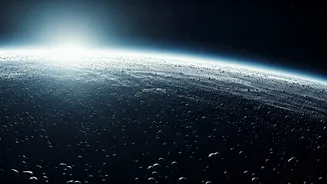
and beautiful. The rings are not solid structures. Instead, they are an enormous collection of countless individual pieces of water ice, with a smaller amount of rocky material mixed in. These pieces range in size from microscopic dust grains, to pebbles, to chunks as large as a car or a house. Each one is in its own orbit around Saturn, moving at incredible speeds—up to 80,000 kilometres per hour. It's the sheer number of these particles and the way they reflect sunlight that creates the illusion of a solid, shimmering plane. They are incredibly thin, too; while they stretch over 280,000 kilometres wide, their vertical thickness is, in most places, only about 10 to 30 metres. This makes them proportionally thinner than a sheet of paper.
The Cosmic Crime Scene
So, where did billions of ice chunks come from? For a long time, scientists believed the rings were primordial, formed from the same cloud of gas and dust that created Saturn itself over 4.5 billion years ago. However, data from NASA's Cassini mission, which spent 13 years orbiting the planet, has completely changed this view. The evidence now points to a much more violent and recent origin story. The leading theory suggests the rings are the debris from a cosmic catastrophe. Sometime in the relatively recent past—perhaps only 100 to 200 million years ago, during the age of dinosaurs on Earth—a large, icy moon may have strayed too close to Saturn. Pulled in by the planet's immense gravity, it would have crossed a boundary known as the Roche limit. Inside this limit, the planet's gravitational pull is stronger than the moon's own gravity holding it together. The moon would have been torn apart, shattering into trillions of pieces that then spread out into the brilliant, icy ring system we see today. The rings aren't a birthmark; they are the glittering remains of a lost world.
A System That 'Rains' Ice
The discoveries from the Cassini spacecraft didn't stop at the rings' origin. During its final, dramatic orbits—dubbed the "Grand Finale"—the probe dived through the gap between Saturn and its innermost ring. What it found was astonishing. The probe's instruments detected a constant, heavy shower of icy particles and chemical compounds being pulled from the rings and funneled down into Saturn’s upper atmosphere. This phenomenon, known as 'ring rain', is a result of the delicate balance between Saturn's gravity pulling material inward and the orbital velocity of the ring particles keeping them aloft. Micrometeoroid impacts and solar radiation also play a role, knocking particles out of their stable orbits. Scientists calculated the rate of this 'rain' and found it was surprisingly intense—enough to fill an Olympic-sized swimming pool every half hour. This constant loss of material means the rings are not a permanent feature.
The Disappearing Spectacle
The discovery of ring rain leads to a poignant conclusion: Saturn's rings are temporary. They are actively draining themselves into the planet they orbit. Based on the rates measured by Cassini and observations from the Voyager probes decades earlier, scientists have put a timeline on their demise. The current estimate is that the rings will be completely gone in less than 100 million years, with some projections suggesting they have even less time. While this sounds like a long time in human terms, it's a cosmic blink of an eye. It means that humanity has evolved at a uniquely fortunate time to witness this celestial wonder. Future inhabitants of the Solar System, millions of years from now, may look up at a ringless Saturn and have to consult ancient records to know that the gas giant was once adorned with such a spectacular crown. We are living in the golden age of Saturn's rings, a fleeting period of cosmic beauty.