


A Glimpse into Alien Skies
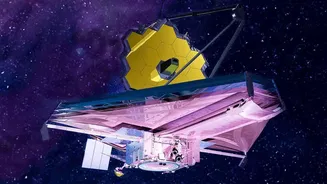
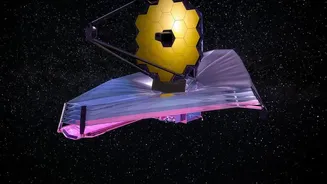
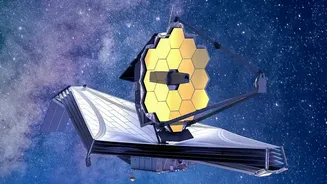
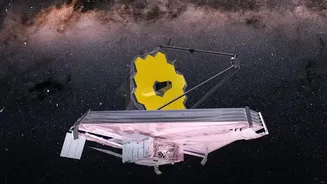
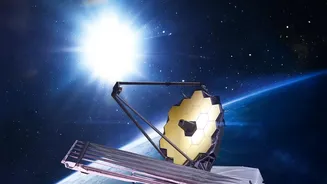
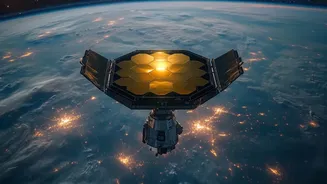
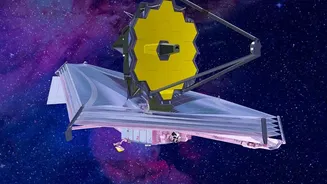
The James Webb Space Telescope (JWST) has been peering into the atmospheres of some of the most common, yet mysterious, types of planets in our galaxy. Recent findings confirm the presence of key molecules, including water vapour, on several of these
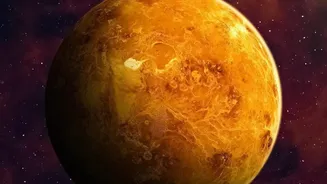
distant worlds. Planets like the scorching hot 55 Cancri e and the enigmatic 'mini-Neptune' GJ 1214 b have been prime targets. For years, GJ 1214 b was a puzzle, its secrets shielded by a thick layer of haze or clouds that older telescopes like Hubble couldn't penetrate. But Webb’s advanced infrared instruments have finally pierced that veil, confirming the presence of water vapour, and possibly methane, within its steamy atmosphere. This is a monumental achievement, proving that our technology can now sniff out the chemical building blocks of life hundreds of light-years away.
What Exactly is a Super-Earth?
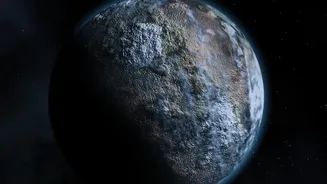
The term “super-Earth” might sound dramatic, but it simply describes a class of planet that we don’t have in our own solar system. These are worlds more massive than Earth but smaller and less gassy than ice giants like Neptune and Uranus. They are incredibly common throughout the galaxy and come in many varieties—some are dense and rocky, while others might be more like 'mini-Neptunes' with thick, extended atmospheres. Because of their increased mass, super-Earths have a stronger gravitational pull, which helps them hold onto their atmospheres over billions of years. This makes them fascinating targets in the search for potentially habitable worlds, as a stable atmosphere is a key prerequisite for liquid water and, therefore, life as we know it.
How Webb Reads a Distant Atmosphere
Detecting what a planet’s air is made of from light-years away sounds like science fiction, but it’s a proven method called transmission spectroscopy. When an exoplanet passes in front of its host star from our perspective, a tiny fraction of the starlight filters through the planet's atmosphere. Different gas molecules absorb specific colours, or wavelengths, of light. The James Webb telescope is exquisitely sensitive to these subtle changes. By capturing the starlight and analysing which colours are missing, astronomers can determine which gases are present—creating a chemical fingerprint of that alien sky. For planets like GJ 1214 b, Webb even tracked it through its orbit to create a 'heat map,' revealing temperature differences between its day and night sides, which further hinted at an atmosphere rich in heavier molecules like water.
Not Habitable, But Hugely Important
It's crucial to manage expectations: finding water vapour on a planet does not mean we have found an ocean or alien life. Most of the super-Earths studied so far, like 55 Cancri e, are incredibly hot 'lava worlds,' with surfaces of molten rock. GJ 1214 b is also far too hot to host liquid-water oceans. However, the breakthrough isn't about the habitability of these specific planets. It’s about proof of concept. The discovery demonstrates that Webb can successfully detect water even on challenging targets. It proves that rocky worlds, even those blasted by intense radiation from their stars, can form and retain substantial atmospheres. This validation of the method is the real prize, paving the way for future investigations of more temperate, Earth-like planets that could be genuinely habitable.
What's Next in the Search for Life?
These findings represent a new chapter in exoplanet research. Astronomers are now compiling lists of other, more promising targets. The focus will shift towards super-Earths orbiting in the 'habitable zone'—the 'Goldilocks' region around a star where temperatures are just right for liquid water to exist on a planet's surface. With the knowledge that Webb can successfully identify water vapour and other atmospheric gases, scientists can now apply these proven techniques to planets like K2-18 b, a super-Earth that lies within its star's habitable zone and is already known to have water in its atmosphere. Each detection is another piece of the puzzle, bringing us incrementally closer to answering one of humanity's most profound questions.