






A Visitor From Another Star
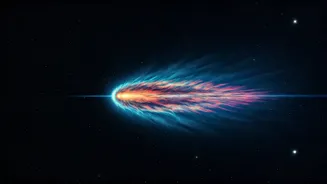
First spotted on July 1, 2025, by the ATLAS survey telescope in Chile, 3I/ATLAS is only the third interstellar object ever detected passing through our celestial neighborhood. The name itself is a giveaway: '3I' stands for the third interstellar object discovered.
Unlike the planets and comets of our solar system, which are gravitationally bound to the Sun in elliptical orbits, 3I/ATLAS is on a one-way trip. Its trajectory is what scientists call 'hyperbolic,' meaning it's moving too fast to be captured by our Sun's gravity. It came in hot, will swing by the Sun, and then head back out into the void, never to return.
Not Just Another Space Rock
What makes 3I/ATLAS so exciting isn't just its foreign origin, but its unique characteristics. Scientists using the James Webb Space Telescope have found its chemical makeup to be strikingly different from comets born in our solar system. It appears to have formed in an extremely cold environment, with some studies suggesting it could be ancient, perhaps even 12 billion years old, born when the Milky Way itself was still forming. This makes it a pristine time capsule from another, much older planetary system. Its composition, rich in certain chemicals and low in others compared to our local comets, gives astronomers a rare chance to study the building blocks of a world formed around a distant, unknown star.
The Comet That Captured Our Imagination
Since its discovery, 3I/ATLAS has sparked a global observation campaign, uniting astronomers and space agencies. More than a dozen NASA missions, from the Hubble Space Telescope to the Parker Solar Probe, have turned their instruments to study this rare guest. This intense scientific interest has spilled over into public fascination. Unlike its enigmatic predecessor, 'Oumuamua, which was a faint, hard-to-observe speck, 3I/ATLAS is unambiguously a comet, complete with a bright coma of gas and dust. This makes it a more tangible and visually compelling subject, a celestial showstopper that has brought back a sense of shared wonder about the night sky.
A Legacy of Cosmic Wanderers
3I/ATLAS joins a very exclusive club with 1I/'Oumuamua (discovered in 2017) and 2I/Borisov (2019). Each visitor has been different. 'Oumuamua was a bizarre, rocky, cigar-shaped object that baffled scientists. Borisov looked more like a conventional comet, but one that came from another star. 3I/ATLAS is different again, appearing to be both very old and chemically distinct. This trio is teaching us that there is a huge diversity of objects drifting between stars. They are physical pieces of other planetary systems, delivered right to our doorstep, allowing us to study the variety of ways solar systems can form and evolve across the galaxy.
Our Window to the Stars
As 3I/ATLAS made its closest pass to the Sun in late 2025, it was too close to the Sun in the sky for Earth-based telescopes to see. However, space-based observatories like the ESA's Juice mission were perfectly positioned to get a front-row seat, gathering precious data during this key phase. Though it posed no threat to Earth, coming no closer than about 270 million kilometers, the wealth of information gathered will keep astronomers busy for years. The comet is now on its way out of our solar system, a fleeting guest that has left a lasting impression. For those of us on the ground, it's a powerful reminder to look up and appreciate the grand, unfolding story of the cosmos, which occasionally sends us a messenger from a faraway place and time.