


Cosmic Forensics by Design
A controlled lunar impact is not a mistake or a mission failure; it's a carefully planned scientific experiment. The technique is simple in concept but powerful in practice. A spacecraft, or a part of it, is precisely guided to collide with a specific
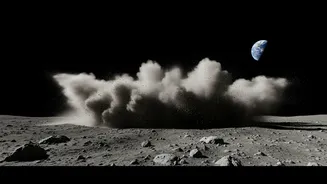
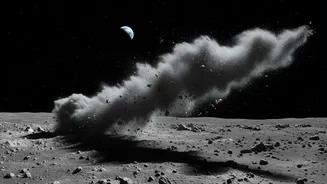
location on the lunar surface. As it hits at immense speed, it vaporises and kicks up a massive plume of dust, rock, and other materials that are normally hidden beneath the surface. This cloud of debris, known as an ejecta plume, rises high above the Moon's surface, sometimes for several minutes. Orbiting spacecraft or even telescopes on Earth can then analyze the sunlight passing through this plume. By studying the light, scientists can determine the exact chemical composition of the material excavated from the crash site. This method allows for a deep look into the Moon's geology without the need for a complex and expensive robotic landing and digging mission.
India's Pioneering Impact
India's space programme played a foundational role in proving the value of this technique. In November 2008, the Indian Space Research Organisation (ISRO) released its Moon Impact Probe (MIP) from the Chandrayaan-1 orbiter. The 29-kilogram probe was designed for a hard landing, and during its 25-minute descent to the south polar region, its instruments were active. Its mass spectrometer, called CHACE, took direct readings of the Moon’s incredibly thin atmosphere. The data sent back just before it crashed near the Shackleton Crater provided some of the first direct evidence of water molecules in the lunar environment. While NASA's M3 instrument, also on Chandrayaan-1, would later confirm water ice across the surface, ISRO's MIP was a trailblazer, demonstrating the value of getting up close and personal, even if the end is a bit destructive.
Confirming a Watery Moon
The search for water has been a primary driver for many impact missions. Just under a year after Chandrayaan-1's impact, NASA conducted its own dramatic experiment with the Lunar Crater Observation and Sensing Satellite (LCROSS) mission in October 2009. The mission sent the large upper stage of its Centaur launch rocket crashing into a permanently shadowed crater near the Moon's south pole. A second, smaller spacecraft flew through the resulting debris plume, analyzing its contents before making its own impact. The results were spectacular. NASA officially announced the mission had successfully uncovered significant quantities of water ice, along with other useful materials like hydrogen gas, ammonia, and methane. The findings from LCROSS and Chandrayaan-1 together transformed our understanding of the Moon from a bone-dry desert to a body with reservoirs of a vital resource.
The Science of a Crash
Beyond water, impacts reveal a wealth of information. During the Apollo era, NASA intentionally crashed spent rocket stages onto the Moon to create artificial 'moonquakes'. Seismometers left on the surface by astronauts recorded the shockwaves, giving scientists vital data about the Moon's internal structure. More recent unplanned impacts, like that of a SpaceX Falcon 9 rocket stage in August 2026, are also treated as scientific opportunities. By observing the resulting crater and ejecta, scientists can refine their models of impact physics. This helps them understand how natural craters form and provides clues about the composition and fluffiness of the lunar soil, or regolith. This knowledge is crucial for planning future missions, especially those involving the construction of habitats or the extraction of resources.
A Smashing Future
The practice of using impacts for science is far from over. As humanity prepares to return to the Moon with programmes like Artemis, understanding the distribution of resources like water ice is more critical than ever. These resources could one day be used to produce drinking water, breathable air, and rocket fuel for missions deeper into the solar system. While many future missions will involve sophisticated landers and rovers, controlled impacts remain a cost-effective way to survey large areas and identify promising locations for more detailed exploration. Even unplanned events provide valuable data, reinforcing the idea that every collision, whether by design or by chance, offers a lesson. They remind us that sometimes, to learn about a world, you first have to make an impact.