


2001: A Space Odyssey (1968)
No list of cinematic space epics is complete without Stanley Kubrick’s masterpiece. Decades before the advent of widespread computer-generated imagery, Kubrick and his team, including special effects pioneer Douglas Trumbull, created visuals so convincing
they still hold up today. The film's weightless sequences were achieved by cleverly hanging actors and sets with wires, often filmed from specific angles to hide the mechanics. The team pioneered techniques like front projection, using massive screens to create the illusion of the prehistoric African savanna on a London soundstage. But the film’s most iconic achievement is the psychedelic “Star Gate” sequence. This was created using an innovative technique called slit-scan photography, which involved exposing film one strip at a time while moving artwork and the camera, resulting in a mesmerizing and reality-bending journey through light and color that redefined what visual effects could be.
Gravity (2013)
Alfonso Cuarón’s survival thriller is less about exploring distant galaxies and more about the terrifying, beautiful reality of being stranded in Earth's orbit. The film was a watershed moment for visual effects, winning seven Academy Awards, including Best Director, Best Cinematography, and Best Visual Effects. The VFX team created an immersive zero-gravity experience that felt startlingly real, blending live-action performances from Sandra Bullock and George Clooney with a digitally created environment. The film’s long, seamless shots, orchestrated by cinematographer Emmanuel Lubezki, create a ballet of chaos and solitude that pulls the viewer directly into the void. The film's technical prowess was so absolute that it swept the Visual Effects Society Awards, prompting host Patton Oswalt to jokingly welcome guests to the "Gravity" awards.”
Interstellar (2014)
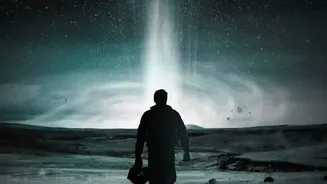
Christopher Nolan’s ambitious epic is as much a scientific treatise as it is a blockbuster film. To ensure accuracy, Nolan collaborated with Nobel Prize-winning theoretical physicist Kip Thorne to visualize complex astrophysical concepts. The film is celebrated for creating what is considered the first scientifically accurate depiction of a black hole, Gargantua. The visual effects team at Double Negative developed new software to render how light would bend around such a massive object, and their simulations were so groundbreaking that they led to the publication of scientific papers. Beyond the black hole, the film brought wormholes and the effects of gravitational time dilation to life with a commitment to realism. The result is a film that balances mind-bending science with awe-inspiring visuals, from giant tidal waves on a water planet to the film's climactic journey into a fifth-dimensional tesseract.
Dune (2021)
While set 10,000 years in the future, Denis Villeneuve’s adaptation of Frank Herbert’s novel feels ancient and tangible. Production designer Patrice Vermette aimed for a grounded, realistic feel, avoiding the sleek, sterile look of many sci-fi futures. The sense of scale is overwhelming; the city of Arrakeen was designed with Brutalist architectural influences to convey the power of its colonial inhabitants. Villeneuve and his team prioritized practical sets and real locations, such as the deserts of Jordan and Abu Dhabi, over green screens to create a more immersive world for the actors and the audience. The film’s aesthetic is a blend of medieval and futuristic, with costume designer Jacqueline West drawing inspiration from history to create over 1,000 distinct looks. The result is not just a visually stunning film, but a fully realized universe that you feel you could almost touch.