




Start Your Mission Online
The first step into the world of space is just a click away. The Indian Space Research Organisation (ISRO) has a wealth of information on its official website, detailing past, present, and future missions. For more structured learning, the Indian Institute
of Remote Sensing (IIRS), a part of ISRO, offers free online courses on topics like space exploration and satellite navigation. These courses often come with a participation certificate and are designed to inspire young minds. Beyond official portals, YouTube channels and science communicators provide engaging content that breaks down complex space science topics into easy-to-understand videos and articles, making it a great starting point for anyone.
Become a Young Scientist with YUVIKA
For a more hands-on experience, ISRO's 'YUva VIgyani KAryakram' (YUVIKA), or Young Scientist Programme, is a flagship initiative. It's a two-week residential program designed to 'catch them young' by imparting basic knowledge on space technology, science, and applications to school students, typically those who have completed Class 9. Selected students from across India get to visit ISRO centres, interact with senior scientists, and participate in activities like model rocketry, robotics, and sky gazing. The selection process is merit-based, considering academic performance, and participation in science fairs and Olympiads, with a special weightage for students from rural areas.
Visit the Universe on Earth
To witness the wonders of the cosmos firsthand, a trip to one of India's many planetariums and science museums is a must. Major cities like Kolkata, Mumbai, and New Delhi have iconic Birla and Nehru Planetariums that offer stunning sky shows and exhibits on space missions. The Birla Science Museum in Hyderabad and Science City in Kolkata also offer immersive experiences. These centres often host workshops, sky-gazing events, and lectures by astronomers, providing a physical space to connect with the universe and like-minded peers. Many planetariums, like the one in Kozhikode, are designed specifically to make science exciting for students.
Get Hands-On with Competitions and Internships
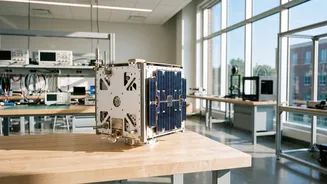
For those who want to apply their knowledge, numerous organizations facilitate competitions and internships. Groups like India Space Lab offer student projects, internships, and training in areas like Drone Technology, CanSat, and CubeSat development. These programs allow students to work on real-world challenges. Similarly, the Indian Space Association (ISpA) runs an internship program for graduates interested in space policy, technology, and research. Even ISRO centres, like the Vikram Sarabhai Space Centre (VSSC), offer limited internship opportunities for students pursuing relevant courses in science and technology.
Chart Your Academic Trajectory
A career in space science requires a strong academic foundation. After Class 10, choosing the science stream with Physics, Chemistry, and Mathematics (PCM) is essential. After Class 12, students can pursue undergraduate degrees like a B.Tech in Aerospace Engineering, Aeronautical Engineering, or related fields from institutions like the Indian Institutes of Technology (IITs). For those aiming to work directly with ISRO, the Indian Institute of Space Science and Technology (IIST) in Thiruvananthapuram is a premier choice. IIST was established to offer high-quality education in space science and technology to meet the demands of India's space program.