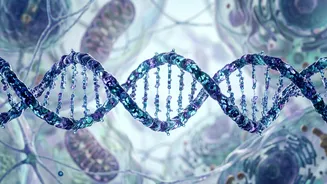









What Is AlphaGenome 2?
AlphaGenome 2 is the latest evolution in Google DeepMind's suite of biological AI models, building on the groundbreaking success of its predecessor, AlphaFold, which revolutionized protein structure prediction. Where AlphaFold focused on proteins, AlphaGenome 2 takes
a much broader view, aiming to understand the complex language of the entire human genome. It is an AI system designed to predict how tiny variations in our DNA sequence might affect the way genes are expressed and regulated within specific human cell types. By analysing these intricate genetic patterns, it helps scientists understand the cellular mechanisms that can lead to disease, offering a more granular view than ever before.
A Leap in Predictive Power
The power of AlphaGenome 2 lies in its precision. Previous models often looked at genetic data at the tissue level, which is a mix of many different cell types. AlphaGenome 2, however, can predict the effects of genetic variants on individual cell types. This is like moving from a blurry satellite map of a city to a detailed street view of a single neighbourhood. For scientists, this means they can more accurately pinpoint which cells are affected by a specific genetic mutation. The model was trained on over 100 million individual cell profiles, allowing it to find nearly twice as many relevant gene variants linked to disease as previous versions. This capability has profound implications for research, potentially accelerating the discovery of drug targets and helping to unravel the complex causes of conditions like cancer and autoimmune disorders.
The Critical 'Research Model' Distinction
Despite its power, DeepMind has been very clear in its messaging: AlphaGenome 2 is a 'research model', not a 'medical diagnostic tool'. This distinction is not just semantics; it's a critical boundary rooted in safety, regulation, and ethics. A research tool is designed to help scientists generate hypotheses and explore biological mechanisms in a lab setting. A diagnostic tool, on the other hand, is used by clinicians to make decisions about an individual patient's health. The latter requires a far higher bar of validation and is subject to stringent regulatory oversight from bodies like India's Central Drugs Standard Control Organisation (CDSCO). An AI tool used for diagnosis in India is classified as a 'Software as a Medical Device' (SaMD) and must undergo rigorous approval to ensure it is safe and effective for clinical use.
From Lab Bench to Doctor's Clinic
The journey from a promising research model to a regulated diagnostic tool is long and expensive. A clinical AI needs to prove its accuracy and reliability across diverse patient populations and real-world conditions, not just with clean lab data. Regulators need to see evidence of robust clinical validation, risk management, and plans for post-market surveillance to monitor performance over time. Traditional medical diagnostics rely on a clinician's ability to integrate test results with a patient's history, a physical exam, and contextual understanding—a process of clinical reasoning that AI currently supports but does not replace. Releasing AlphaGenome 2 as a research tool allows DeepMind to get it into the hands of scientists quickly to accelerate discovery, while its commercial-focused sibling company, Isomorphic Labs, works on applying similar AI models to the slower, more rigorous process of drug design.
What This Means for the Future of Medicine
By framing AlphaGenome 2 as a research tool, DeepMind is practicing responsible innovation. It avoids the hype and potential harm of people or clinicians misinterpreting a predictive score as a definitive diagnosis. However, the long-term potential is immense. Tools like AlphaGenome 2 will massively accelerate our understanding of the genetic underpinnings of disease. This, in turn, will fuel the development of the next generation of truly diagnostic AI and personalized treatments. It allows researchers to fail faster, iterate quicker, and focus their experiments on the most promising genetic pathways identified by the AI. While AlphaGenome 2 won't be diagnosing you at your next doctor's visit, it may have helped discover the treatment your doctor prescribes a decade from now.