







The Great Lunar Freeze
Landing on the Moon is a monumental achievement, but staying operational is another challenge entirely. The primary obstacle is the lunar night, a period of about 14 Earth days without sunlight. Without an atmosphere to trap heat, the surface temperature
plummets dramatically, dropping to as low as minus 173 degrees Celsius. This extreme cold is lethal to the batteries and electronics that are the heart and brain of any robotic explorer. Without a power source to keep them warm, components can crack, circuits can fail, and a groundbreaking mission can be frozen into a permanent monument.
The Solar-Powered Dilemma
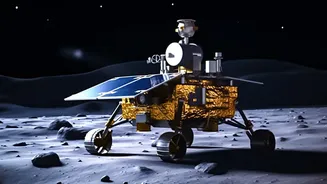
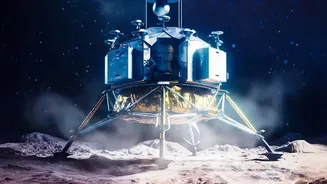
Many lunar missions, including India’s historic Chandrayaan-3, have relied on solar panels for power. This is an effective and cost-efficient strategy for the lunar day. The Vikram lander and Pragyan rover performed brilliantly, conducting valuable science near the Moon's south pole. However, they were designed for a mission life of just one lunar day. As night approached, ISRO scientists put the rover and lander into a 'sleep mode' with fully charged batteries, hoping they might awaken when the sun returned two weeks later. Unfortunately, without a dedicated heating system to endure the intense cold, the chances of survival were slim. This highlights the fundamental limitation of solar-only missions: their lifespan is tied to the sun.
A Tiny Nuclear 'Hand-Warmer'
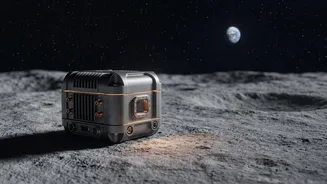
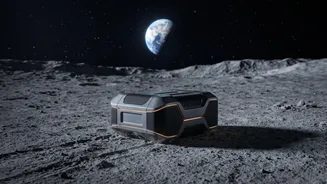
The solution to surviving the lunar night is not a massive power plant, but a small, incredibly reliable device called a Radioisotope Heater Unit, or RHU. Think of it as a nuclear-powered hand-warmer for vital electronics. These units are remarkably simple and robust. About the size of a small battery, each RHU generates about one watt of continuous heat. They have no moving parts and require no electrical input, making them a perfect passive heating system. By strategically placing a few RHUs inside a rover's electronics box, engineers can keep the most sensitive components—like the flight computer and batteries—just warm enough to prevent damage from the deep freeze.
The Science of Steady Heat
The technology behind an RHU is based on the natural process of radioactive decay. Inside each unit is a small, ceramic-encased pellet of plutonium-238. This specific isotope decays over time, releasing a steady and predictable amount of heat for decades. This is not a nuclear reactor; there is no chain reaction. It's a slow, gentle release of thermal energy. The heat simply radiates outward, warming whatever is nearby. This differs from their larger cousins, Radioisotope Thermoelectric Generators (RTGs), which are more complex systems designed to convert heat into electricity. RHUs are built for one purpose only: providing a simple, reliable source of life-sustaining warmth in the coldest, darkest environments.
Unlocking the Moon's Secrets
By enabling rovers to survive the lunar night, RHUs fundamentally change the scope of lunar exploration. A mission is no longer a two-week sprint but can become a marathon lasting for months or even years. This longevity has a massive impact. It allows a rover to travel much farther, study seasonal changes, and wait for the perfect conditions to conduct specific experiments. It dramatically increases the scientific return on a very expensive investment. This technology isn't new; it has been proven on countless deep space and planetary missions, including the legendary Mars rovers Spirit and Opportunity, which used RHUs to keep their batteries functional far beyond their initial mission plans. As commercial companies and national agencies like NASA plan for a more sustained presence on the Moon, RHUs are becoming a standard piece of the toolkit.