






How AI Learns to Write Like You
The most effective AI email assistants don't just follow generic commands; they study you. The best tools analyze the emails you've already sent to learn your specific writing style. This goes far beyond simply being told to be 'friendly' or 'formal'.
The AI observes your typical greetings and sign-offs, your sentence length, your vocabulary, and even the unique phrases you use in recurring situations. Some tools achieve this by having you provide a dozen or so writing samples, while more advanced systems integrate with your inbox (like Gmail or Outlook) to create a private, personalized tone model from your entire email history. This method is what separates a truly personal AI assistant from a generic text generator. Instead of starting from a blank slate, the AI uses your past communication as a blueprint.
Mastering Personalization Features
AI assistants offer a suite of features designed to bridge the gap between automation and authenticity. A key feature is the ability to adjust tone on the fly. You can take a draft and ask the AI to make it more concise, more casual, or more assertive, refining the output to match the specific context of a conversation. Many tools also allow you to create and save custom writing styles for different scenarios, such as a 'formal client update' versus a 'casual team check-in'. Furthermore, some AI assistants can connect to your other data sources, like your Google Drive or calendar, to pull in relevant details, making the drafted email not only sound like you but also demonstrate a deep awareness of the context.
The Art of the Prompt
Even with an AI that knows your style, your input remains crucial. The quality of the draft often depends on the quality of your prompt. Instead of a vague request like “reply to this,” providing specific instructions yields far better results. You can guide the AI by telling it your goal for the email. For example, specify that you want to “politely decline the invitation but suggest a coffee next month” or “enthusiastically agree to the proposal and list three follow-up questions.” You can also give the AI a persona or role, instructing it to write as a helpful project manager or a direct-to-the-point executive. This initial guidance shapes the entire draft and dramatically reduces the amount of editing needed.
You Are Always the Final Editor
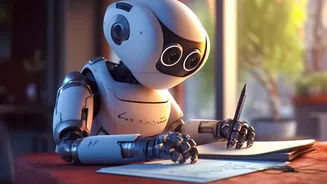
No matter how sophisticated the AI, the most critical step in maintaining your personal voice is the final human review. An AI-generated draft is just that—a draft. It’s a starting point designed to save you from the effort of staring at a blank page. Your job is to read it over, catch any awkward phrasing, correct potential errors in tone, and add the final layer of nuance that is uniquely yours. Think of the AI as a hyper-efficient junior assistant; it can handle about 80% of the work, but it needs your oversight and final approval before anything is sent. This human-in-the-loop process ensures quality control and guarantees that the final message truly reflects your voice and intent, preserving your relationships and professional credibility.