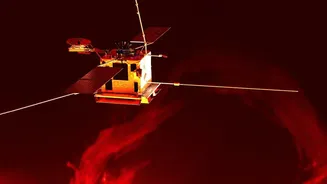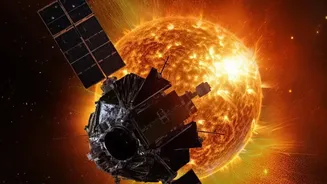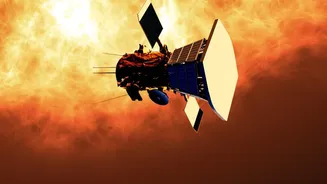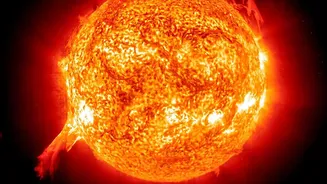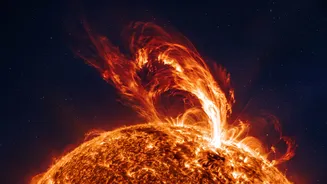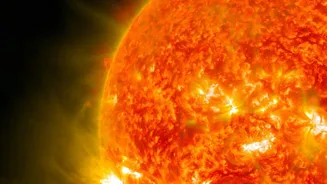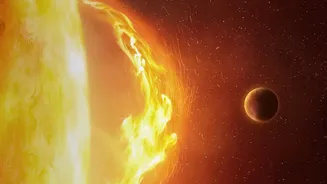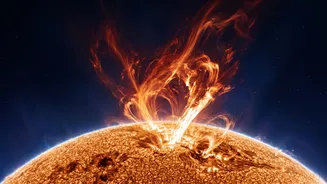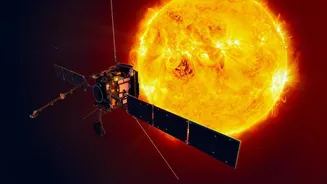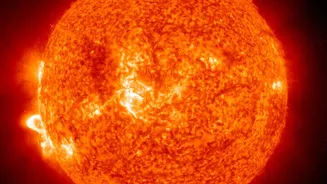



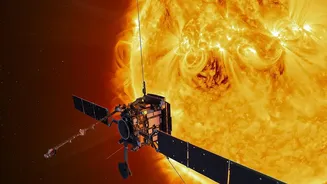

Two of the world's most advanced solar observatories, India's Aditya-L1 and Europe's Proba-3, are joining forces. This landmark collaboration promises to unravel the violent secrets of solar eruptions close to the Sun's surface.
India's Unblinking Eye on the Sun
Launched by ISRO in September
2023, Aditya-L1 is India's first dedicated mission to study the Sun. It is strategically positioned at Lagrange Point 1 (L1), about 1.5 million kilometres from Earth, where it has a continuous, uninterrupted view of our star. Aditya-L1 is equipped with seven sophisticated instruments designed to observe the Sun's outer layers, the photosphere, chromosphere, and the corona. One of its key payloads is the Visible Emission Line Coronagraph (VELC), which is designed to study the solar corona and the dynamics of Coronal Mass Ejections (CMEs), the massive bursts of plasma and magnetic fields from the Sun. These CMEs are a primary driver of space weather, which can disrupt satellites, power grids, and communication systems on Earth.
Europe's Artificial Eclipse in Space
The European Space Agency's (ESA) Proba-3 mission, launched in December 2024 aboard an Indian PSLV rocket, is a technological marvel. It consists of two satellites flying in precise formation, approximately 150 metres apart. One satellite, the 'Occulter', blocks the bright face of the Sun, casting a precise shadow over the second satellite, the 'Coronagraph'. This creates a sustained artificial solar eclipse, allowing its ASPIICS instrument to capture incredibly detailed images of the Sun's faint, super-hot corona—a region normally invisible due to the Sun's intense glare. This innovative formation flying allows for observations of the inner corona that were previously impossible to achieve with single-spacecraft missions.
A Partnership of Complementary Strengths
The power of this partnership lies in how the two missions complement each other. While Aditya-L1 provides a constant, wide-angle view and spectroscopic data—analysing the properties of the light to understand temperature and density—Proba-3 provides exceptionally sharp, close-up images of the corona's structure. Scientists can combine VELC's spectroscopic data, which details the properties of the hot gas in an eruption, with the high-resolution images from Proba-3's ASPIICS instrument. This allows them to build a more complete, three-dimensional picture of a CME as it blasts off from the Sun, cross-checking measurements of its mass, speed, and energy with unprecedented accuracy.
First Results and Future Promise
Researchers have already demonstrated the value of this joint effort by analysing two CMEs observed in September 2025. The combined data revealed crucial details about how the eruptions evolved in their earliest stages near the Sun. One CME was fast moving at around 645 km/s, while the other was much slower at 145 km/s, and the joint observations helped explain how their density and energy changed as they moved away from the Sun. This type of detailed analysis is critical for improving space weather models and our ability to predict the impact of solar storms on Earth. The success of these initial joint observations has paved the way for deeper collaboration, including a joint ISRO ESA workshop held in January 206 to foster long term scientific partnerships.