




The Foundation: Mastering Tree Pose
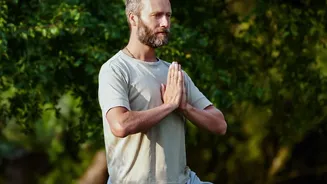
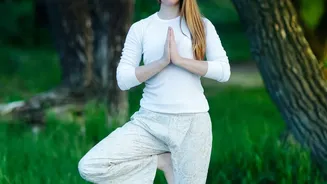
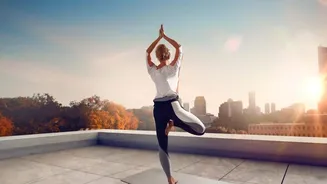
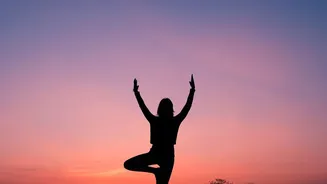
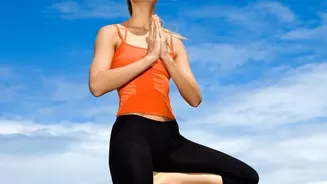
Vrikshasana, or Tree Pose, is a foundational standing balance that teaches us stillness, focus, and strength. The pose mirrors the image of a tree: rooted, stable, and growing upwards. It strengthens the muscles in the standing leg, particularly the ankles
and calves, while also improving posture and concentration. To practice, you stand on one leg, placing the sole of the other foot on your inner ankle, calf, or thigh—always avoiding direct pressure on the knee. This action of rooting down through the standing foot while lengthening the spine cultivates a sense of groundedness. Finding a fixed point to gaze at, known as a 'drishti', is key to steadying the mind and, in turn, the body. Mastering Tree Pose isn't about achieving perfect stillness, but about learning to make tiny adjustments to maintain your balance, embracing the gentle sways just as a tree does in the wind.
The Challenge: Understanding Warrior III
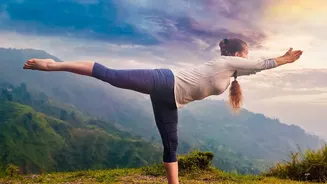
Warrior III, or Virabhadrasana III, takes the balance learned in Tree Pose and adds a dynamic, full-body element. It is a powerful posture that builds strength along the entire back of the body, tones the abdomen, and intensely challenges your stability. In this pose, you balance on one leg while extending the other leg straight behind you, hinging at the hips until your torso and lifted leg are parallel to the floor. Your arms can be extended forward, out to the sides, or kept at your chest. This posture demands an integration of strength, flexibility, and unwavering focus. Unlike the vertical stillness of Tree Pose, Warrior III requires you to create a straight, energetic line from your head to your lifted heel, engaging your core deeply to prevent your chest or leg from dropping.
From Roots to Wings: The Progression
Viewing Warrior III as a progression from Tree Pose helps demystify its difficulty. Tree Pose builds the essential components needed for Warrior III: a strong standing leg, ankle stability, and the ability to maintain focus. Once you feel steady in Vrikshasana, you have already trained your body for the foundational part of Virabhadrasana III. The transition itself becomes the next step in the practice. Think of Tree Pose as establishing your roots. Warrior III then asks you to take those roots and use them as a launchpad, extending your energy forward and back into a new plane. This progression teaches you to carry your stability from a static position into a dynamic one, a skill that enhances coordination and body awareness.
A Step-by-Step Guide to Transition
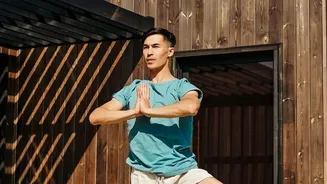
Moving from Tree Pose to Warrior III can be a graceful and empowering sequence when done with intention. Begin in a stable Tree Pose, with your hands at your heart center. Take a deep breath to ground yourself. As you exhale, begin to unlock the knee of your lifted leg and slowly send it straight back behind you. Simultaneously, start to hinge forward at the hips of your standing leg, keeping your spine long. The key is to move the torso and the back leg as one unit, as if connected by a single rod. Continue to extend your back leg and lower your torso until they are roughly parallel to the floor. Keep a micro-bend in your standing knee to avoid locking the joint and to maintain active muscle engagement. Throughout the movement, keep your core engaged and your hips level, pointing downwards toward the mat. To come out, reverse the motion with control, returning to Tree Pose before lowering your foot.
Tips for a Stable Practice
Wobbling is a natural part of learning. To build confidence, don't hesitate to use props. Practicing near a wall for support is an excellent way to understand the alignment without the fear of falling. You can place your hands on the wall in front of you as you extend your back leg. Another common challenge in Warrior III is the tendency for the hip of the lifted leg to open upwards. Make a conscious effort to keep both hip points facing the floor. Actively flex the foot of your lifted leg and imagine you are pressing it into a wall behind you; this will engage the entire leg and help with balance. Finally, remember to breathe. Holding your breath creates tension and instability. A steady, even breath will calm your nervous system and support your focus.