



The Cosmic Speed Limit
To understand this cosmic time travel, we first need to talk about speed. Light is the fastest thing in the universe, travelling at an incredible 3,00,000 kilometres per second. It’s so fast it can circle the Earth more than seven times in a single second. But
as fast as that is, space is unimaginably vast. The distances between stars are so enormous that even light takes years, centuries, or even millennia to cross them. This is where the concept of a 'light-year' comes from. It's not a measure of time, but of distance: it’s the distance light travels in one year, which is about 9.5 trillion kilometres. When an astronomer says a star is 100 light-years away, they mean it is 950 trillion kilometres from us. This immense scale is the key to seeing back in time.
Your Personal Time Machine
Because light takes time to travel, the starlight we see tonight did not leave its star tonight. It left a long, long time ago. Think of it like receiving a letter sent by post from a distant country; the news inside is already old by the time you read it. The universe works the same way, but on a much grander scale. The Sun, our closest star, is about 150 million kilometres away. Its light takes about 8 minutes and 20 seconds to reach us. This means if the Sun were to suddenly vanish, we wouldn’t know about it for over eight minutes. Every time you look at the Sun (with proper protection, of course!), you are seeing it as it was eight minutes ago. For stars, this delay is much more dramatic. The nearest star system to us, Alpha Centauri, is over four light-years away. The light we see from it tonight left during a time when many of us were in different jobs or schools. The night sky isn't a live broadcast; it’s a collection of historical records.
Stars and Our History
This is where things get truly mind-bending. Many of the familiar stars in our sky are so far away that their light began its journey to Earth during major events in our own history. Let’s take Polaris, the North Star. It is approximately 433 light-years away. The light we see from Polaris tonight started its journey around the year 1591. At that time in India, the Mughal Empire under Emperor Akbar was at its peak of power and cultural influence. In England, William Shakespeare was just beginning to write his famous plays. When you look at Polaris, you are seeing a photon that left its star when the world was a vastly different place. Consider Betelgeuse, the bright red giant in the Orion constellation. It is about 640 light-years away. Its light began travelling towards us around the year 1384, during the tumultuous late period of the Tughlaq dynasty in the Delhi Sultanate, shortly before the devastating invasion by Timur. Or take Rigel, Orion’s bright blue-white star. At roughly 860 light-years away, its light dates back to the 12th century, a time when the Chola dynasty in South India was a dominant maritime power.
Beyond Stars to Distant Galaxies
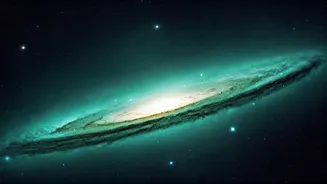
This principle doesn't just apply to stars in our own galaxy. When we look at other galaxies, we are peering millions or even billions of years into the past. The Andromeda Galaxy, the closest major galaxy to our own Milky Way, is about 2.5 million light-years away. The light we see from it today is 2.5 million years old. When that light began its journey, modern humans did not exist. Our early ancestors, like Homo habilis, were just beginning to walk the Earth. The most powerful telescopes, like the James Webb Space Telescope, are essentially cosmic time machines. They can see galaxies so far away that they are observing them as they were over 13 billion years ago, giving us a glimpse of the universe in its infancy. We are seeing the 'baby pictures' of the cosmos, all because of the finite speed of light.