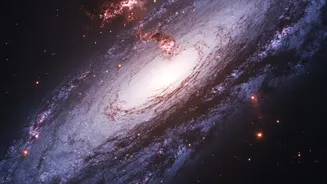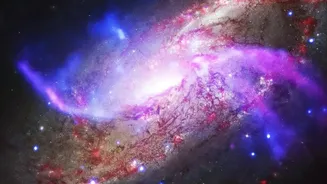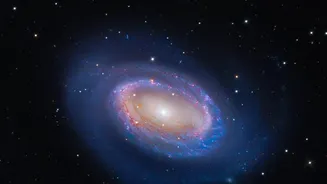


More Mature Than They Should Be
The universe is about 13.8 billion years old, a timeline that provides a strict framework for how galaxies should form. Models have long predicted that the very first galaxies, seen just a few hundred million years after the Big Bang, would be small,
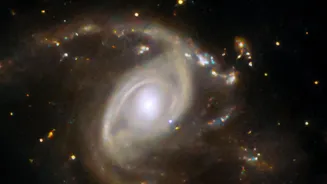
chaotic, and just beginning to assemble themselves. However, recent data from the JWST is showing something entirely different. Astronomers are observing galaxies from this early era that appear surprisingly mature, bright, and chemically complex. This suggests that the process of building galaxies, and the stars within them, may have happened much faster and earlier than anyone anticipated.
The Case of the Overachieving Galaxies
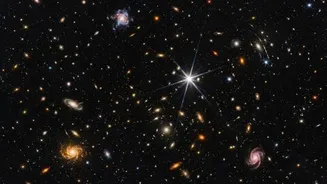
Take JADES-GS-z14-0, currently the most distant galaxy ever confirmed. Its light has traveled for over 13.5 billion years to reach us, meaning we see it as it was less than 300 million years after the Big Bang. According to previous theories, a galaxy this young should be a faint flicker. Instead, JADES-GS-z14-0 is unexpectedly bright. Even more puzzling is the detection of elements like nitrogen and oxygen. These elements are forged inside stars and scattered when they die. Finding them in such an early galaxy implies that at least one generation of stars had already lived and died, a process that was thought to take much longer.
Rewriting the Cosmic Playbook
These findings are forcing a major rethink. One possibility is that our understanding of cosmology needs a significant adjustment. Perhaps the universe's 'dark ages'—the period before the first stars lit up—was shorter than we thought. Another theory is that the first stars were far more massive and burned through their fuel much more quickly than modern stars, allowing them to enrich their galactic homes with heavy elements at an accelerated pace. Some discoveries are even more unusual, like galaxies that appear to be missing dark matter, the invisible substance thought to be the cosmic glue holding them together. The discovery of a string of these 'ghostly' galaxies suggests extreme events, like violent galactic collisions, were happening very early on and shaping the cosmos in ways we've never seen before.
From a Trickle of Data to a Flood
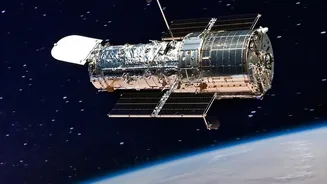
Before the James Webb Space Telescope, astronomers could only get glimpses of this primordial era. The Hubble Space Telescope could spot some early galaxies, but their details were obscured. The JWST, with its powerful infrared vision, can cut through the cosmic dust and gas to see these distant objects with unprecedented clarity. It has turned a few puzzling data points into a growing collection of surprisingly advanced early galaxies. This allows scientists to move from identifying single oddities to studying a population, helping them determine whether these mature galaxies are rare exceptions or the norm for the early universe.
What Happens Next?
The work is far from over. Each new discovery opens up more questions. Astronomers are now using the JWST to perform detailed spectroscopic analysis on these distant objects. This technique breaks down the light from a galaxy into its constituent colors, revealing precise information about its distance, chemical composition, and the types of stars within it. By studying more of these early systems, like the recently identified 'Little Red Dots' which may be powered by supermassive black holes, scientists hope to build a new and more accurate timeline of the universe's first billion years. The goal is to understand the fundamental processes that set the stage for everything that followed, including the formation of our own Milky Way galaxy.