



The Monsoon’s Double-Edged Sword
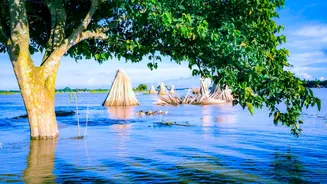
Kayaking in Meghalaya during the monsoon is the definition of high-volume. This isn't just about more water; it's about a fundamental change in the river's character. Rainfall can exceed 300-500mm in a single day, leading to dramatic and rapid rises in water levels.
Rivers that are manageable in the dry season transform into raging torrents. This is what experts call “high-volume” kayaking, where the sheer force of the water becomes the primary feature and hazard. Flash floods are a constant threat, capable of turning a gentle stream into a life-threatening surge with little warning. The immense power of the water can shift giant boulders, create new and unpredictable rapids, and form dangerous hydraulic features like powerful holes and siphons—where water flows under rocks with immense force, creating a deadly trap. The crystal-clear waters famous in winter turn muddy and brown, hiding submerged obstacles and making it impossible to read the riverbed visually.
Communication Beyond Words
In the roar of a monsoon-fed canyon, shouting is useless. Effective communication relies on a clear, pre-established system of non-verbal signals. Before even getting on the water, the entire group must be fluent in the same set of hand, paddle, and whistle signals. A vertical paddle means 'go', a horizontal one means 'stop'. Pointing with an open hand indicates the safe channel, while a fist signals danger. A whistle blast can mean 'attention', while a series of blasts can signal an emergency. This silent language is the lifeline of the group. It allows the lead kayaker to guide the team through a complex rapid, for a kayaker in trouble to signal for help, and for the entire group to halt and regroup instantly if a new hazard appears. Echoing signals down the line ensures everyone, from the lead to the sweep at the back, has the same critical information.
The Unbreakable Chain of Command
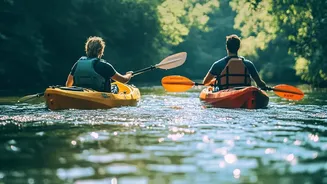
A kayaking group is not a democracy, especially in high-stakes environments. It is a well-oiled team with clearly defined roles. Typically, this includes a Lead, a Sweep, and the paddlers in between. The Lead paddler is often the most experienced, responsible for setting the pace, reading the river, and choosing the safest line through a rapid. They are the first to encounter the challenges. The Sweep paddler is also highly skilled and positioned at the very back of the group. Their job is crucial: to assist anyone who gets into trouble, retrieve gear, and ensure no one is left behind. The paddlers in the middle are responsible for maintaining spacing, staying compact as a group, and watching out for the person in front of and behind them. This structure ensures that there are eyes on every member of the team at all times, transforming a collection of individuals into a cohesive safety unit.
Scouting: A Collective Decision
One of the most critical group activities is scouting. When a complex or dangerous rapid appears, the mantra is simple: “If in doubt, get out and scout.” The entire group pulls over to a safe eddy before the rapid. From the riverbank, they collectively analyse the flow of water, identify hazards like hidden rocks or siphons, and plan the safest route, or 'line', through the rapid. They also plan for contingencies. Where are the safe zones (eddies) within the rapid? What's the rescue plan if someone flips or 'swims'? This collaborative process is vital. It pools the experience and perspectives of the entire group, often leading to a safer and more conservative decision than one person might make alone. It also ensures everyone understands the plan and their role in executing it before committing to the rapid.
The Rescue Chain: Your Buddy is Your Lifeline
When an incident occurs—a flipped kayak, a swimmer in the water—the group's coordination is put to the ultimate test. A well-drilled team has a rescue plan that activates instantly. The first priority is the swimmer. Nearby paddlers provide immediate support, possibly performing a T-rescue to right the boat or throwing a rope. The rest of the group acts as a safety net downstream, positioning themselves to intercept the swimmer or loose equipment. No one paddles on ahead. The principle is that the group is only as strong as its weakest link, and a person in the water is the most vulnerable link. This organised response prevents a minor incident from escalating into a major emergency. It ensures that a swimmer is quickly brought to safety, preventing exhaustion and hypothermia, which are significant risks even in warm water when adrenaline wears off.