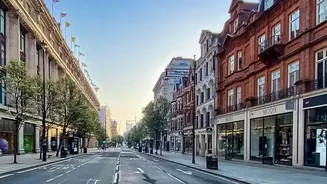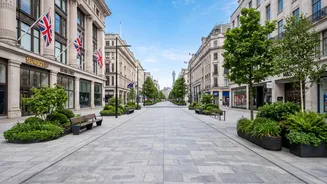




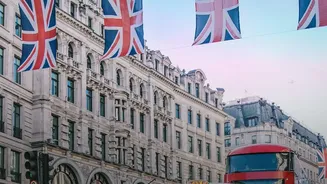
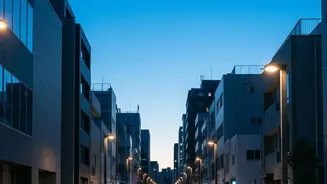
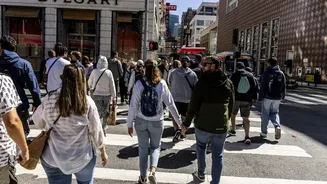
London's famous Oxford Street took a historic step in late October 2026, going permanently traffic-free along its core stretch. This long-debated move isn't just a local story; it's part of a global shift toward people-first cities.
London's Landmark Shift
After decades of discussion,
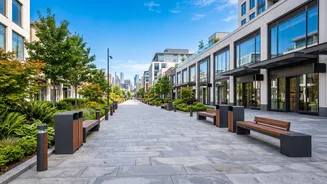
a nearly one-kilometre section of Oxford Street, from Orchard Street to Great Portland Street, is now closed to most vehicles, including buses, taxis, and cycles. The change, which took effect on October 26, 2026, aims to transform the iconic shopping destination into a safer, more pleasant public plaza. Mayor Sadiq Khan hailed it as a 'truly momentous occasion for the capital'. While the initial phase involves temporary measures like new seating and plants, a full redesign with public squares and more greenery is planned for 2027 and beyond. The goal is to elevate Oxford Street to the level of other world-class destinations, prioritising shoppers and visitors over traffic.
Strøget, Copenhagen: The Original Pioneer
Long before London, Copenhagen showed the world what was possible. In 1962, the city converted its main street, Strøget, into a pedestrian-only zone. At the time, the idea was controversial. Businesses feared they would lose customers, and critics claimed a 'pedestrian street will never work in Scandinavia'. However, the experiment was a resounding success. The 1.1-kilometre street became a vibrant hub for locals and tourists, proving that foot traffic could be great for business. Today, Copenhagen's central pedestrian network has expanded to cover about 100,000 square metres, influencing cities worldwide to rethink their own urban cores.
Shibuya Crossing, Tokyo: The Scramble
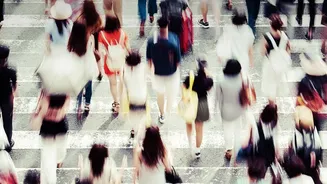
While not a pedestrian street in the traditional sense, Tokyo's Shibuya Crossing is arguably the world's most famous pedestrian intersection. When the traffic lights turn red, they stop vehicles in all directions, allowing a massive wave of people—sometimes up to 2,500 at once—to 'scramble' across the intersection from every angle. This organised chaos, which began in 1973, has become an iconic symbol of modern Tokyo, featured in numerous films. It’s a powerful demonstration of prioritising pedestrian flow in one of the most densely populated urban areas on Earth, handling millions of people daily with remarkable efficiency.
Las Ramblas, Barcelona: A Cultural Artery
Stretching 1.2 kilometres to the sea, La Rambla is the vibrant, tree_lined heart of Barcelona. It's more than a street; it's a sequence of boulevards with a wide central promenade that functions as the city’s social and cultural artery. Though flanked by narrow service roads, the pedestrian experience is paramount, filled with market stalls, performers, and cafes. The Spanish poet Federico García Lorca famously said it was 'the only street in the world which I wish would never end'. Barcelona is now undertaking a major transformation of La Rambla, set for completion in early 2027, to give even more space back to pedestrians and solidify its people_first identity.
Rue Mouffetard, Paris: A Market Reclaimed
One of Paris's oldest streets, Rue Mouffetard in the Latin Quarter offers a different kind of pedestrian experience. Following the path of an ancient Roman road, this narrow, cobbled street is a bustling open_air market beloved by locals and famously described by Ernest Hemingway. For much of the week, it's closed to traffic, allowing shoppers to browse fresh produce, cheeses, and baked goods from historic storefronts. Its medieval character was preserved when it was spared from Haussmann's 19th_century redevelopment of Paris. 'La Mouffe,' as locals call it, is a testament to how pedestrianisation can protect and enhance a neighbourhood's historic charm and function as a lively community hub.