




Lighthouses of the Cosmic Dawn
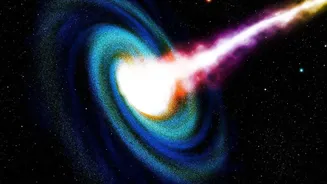
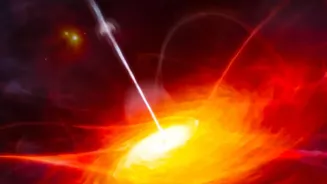
To understand the excitement, we first need to know what a quasar is. Imagine a supermassive black hole, millions or even billions of times the mass of our Sun, sitting at the heart of a young galaxy. As it pulls in surrounding gas and dust, the material
forms a super-heated, intensely bright disc. This celestial engine is a quasar, and it can outshine its entire host galaxy. Because their light travels for billions of years to reach us, quasars act like cosmic lighthouses, illuminating the universe's infancy—a period known as the 'Cosmic Dawn', just after the first stars and galaxies were born. Finding them is key to understanding how we got from the Big Bang to the structured universe we see today.
A Discovery That Shouldn't Exist
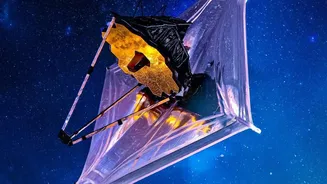
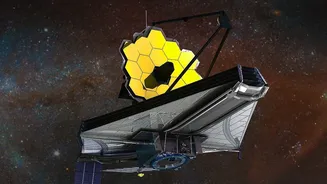
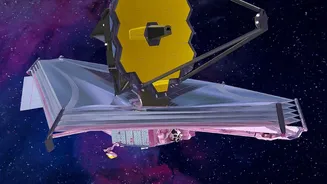
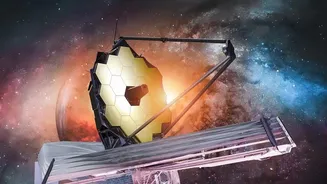
Using data from its Aether survey, which is building a census of early universe objects, the JWST identified J1602+4228AB. Follow-up observations with the Gemini North telescope in Hawaiʻi confirmed it was a pair of quasars seen as they were just 900 million years after the Big Bang. This discovery is puzzling because current theories don't easily explain their existence. The black holes powering them are enormous—one is about 1.5 billion times the Sun's mass, the other 400 million. According to models, black holes shouldn't have had enough time to grow this massive so early in cosmic history. As one researcher noted, there's no definitive explanation for how even one of these giants exists so early, let alone two together.
Two Giants in a Cosmic Dance
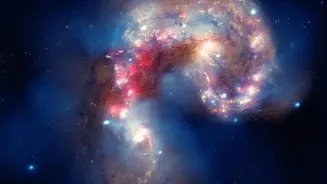
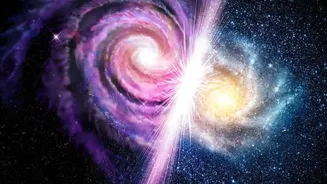
What makes J1602+4228AB—nicknamed Nāpōwawāʻenakaulua—truly special is that it is a 'pair'. The two quasars are separated by just 18,100 light-years, which is incredibly close on a cosmic scale—about one-fifth the diameter of our own Milky Way galaxy. This makes it the most compact quasar pair ever found from this era. Their proximity is a tell-tale sign of two galaxies in the chaotic process of merging. Galaxy collisions were more common in the early universe and are believed to be the primary way large galaxies form, funnelling fuel into their central black holes and igniting them as quasars. J1602+4228AB provides direct, visual evidence of this crucial process happening at the dawn of time.
Rewriting the Rules of Galaxy Growth
Finding this system throws a wrench in the works of our understanding of galaxy formation. Quasar pairs have long been predicted by theory, but they are exceptionally rare to find, especially at such an immense distance. J1602+4228AB is only the third such pair found from the Cosmic Dawn. Its existence suggests that the processes of galaxy assembly and black hole growth may have happened much faster and more furiously than previously thought. The system likely sits in an unusually dense patch of the early universe, where frequent interactions could accelerate the growth of both galaxies and their central black holes. This discovery serves as a crucial benchmark, forcing astronomers to refine their models to account for such early, massive structures.