



The Persistent Martian Menace
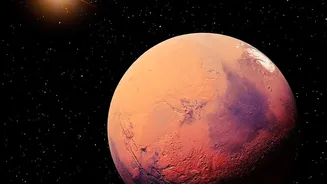
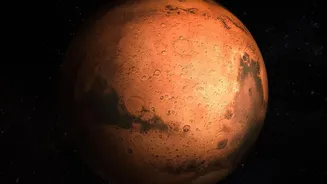
The fine, reddish dust on Mars is more than just a surface coating; it's a mission killer. Unlike the coarse sand of Earth's deserts, Martian dust particles are tiny and slightly electrostatic, causing them to cling to surfaces like styrofoam. For solar-powered
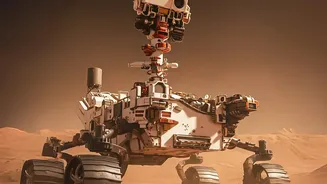
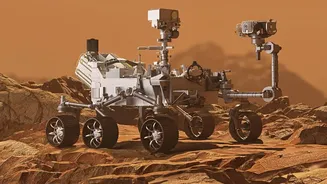
landers and rovers, this is a slow-motion catastrophe. A thin layer of dust can significantly reduce the efficiency of solar panels, cutting off the power needed for science, movement, and even basic survival. The most famous victim of this phenomenon was NASA's Opportunity rover. Designed for a 90-day mission, it explored Mars for nearly 15 years before a colossal, planet-encircling dust storm in 2018 blotted out the sun. The storm was so thick that not enough sunlight could penetrate the atmosphere to charge Opportunity's batteries, and the rover fell silent forever. More recently, the InSight lander also succumbed to dust accumulation, ending its mission in late 2022 after its power levels dwindled. These events highlight a critical vulnerability for robotic and future human exploration: to survive on Mars, you have to survive its weather.
Eyes in the Martian Sky
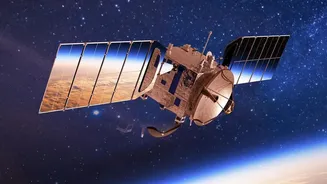
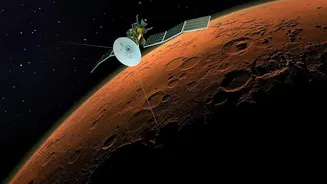
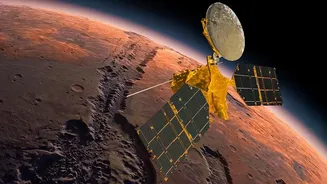
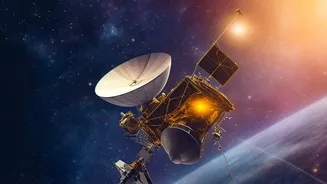
Fortunately, we aren't flying blind. A fleet of orbiters constantly circle Mars, serving as our weather satellites for the Red Planet. Chief among them is NASA's Mars Reconnaissance Orbiter (MRO), a multi-talented spacecraft that has been studying the planet for nearly two decades. MRO is equipped with a suite of powerful instruments, but two are key to tracking dust: the Mars Color Imager (MARCI) and the Mars Climate Sounder (MCS). MARCI acts like a global weather camera, capturing a daily map of the entire planet that allows scientists to spot developing storms and track their growth visually. The MCS, however, provides a different, crucial perspective. It doesn't just see the dust; it measures its impact on the atmosphere by profiling temperature at different altitudes. Together, these instruments provide a comprehensive, three-dimensional view of how dust moves and behaves.
From Weather Report to Predictive Map
Spotting a storm is one thing; predicting its path is another. Scientists are now using the long-term data from orbiters like MRO to move from simple observation to genuine forecasting. The MCS instrument allows researchers to see how dust absorbs sunlight and heats up the atmosphere. By mapping these temperature changes, they can infer the density and altitude of the dust clouds. This data has revealed predictable patterns. For example, certain types of large, regional storms tend to originate in specific areas, like the Acidalia Planitia region, and follow established tracks during certain seasons. By combining years of these thermal profiles and visual maps, scientists can build and refine climate models that show how and where storms are likely to intensify. Recent studies have even linked sharp rises in surface temperature to the subsequent formation of major storms, offering a potential warning sign. This turns orbital data into a true forecasting tool, allowing mission planners on Earth to anticipate when and where the dust will fly.
A Blueprint for Safer Missions
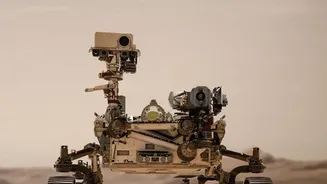
This ability to forecast Martian weather has profound implications for exploration. While current flagship rovers like Curiosity and Perseverance are nuclear-powered and thus immune to the solar panel problem, future missions may rely on solar energy for its scalability. Knowing a major storm is coming could allow a future solar-powered rover to conserve energy by entering a low-power hibernation mode, as Opportunity and InSight did. Even more importantly, these storm maps can influence where we choose to land. By identifying regions that are less prone to severe dust activity, mission planners can select safer and more stable landing sites for both robotic and, eventually, human missions. Understanding dust behaviour is also critical for Entry, Descent, and Landing (EDL) sequences, as atmospheric density changes can affect a spacecraft's trajectory. Ultimately, the work being done by orbiters high above Mars is creating a vital instruction manual for living and working on its surface, ensuring that future explorers have the foresight needed to weather the storm.