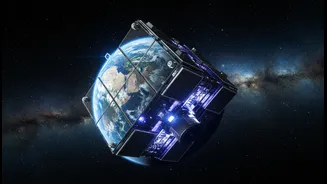









Why Move Data Centers to Space?
The core idea behind space-based AI computing is to solve a growing terrestrial problem. On Earth, data centers are massive consumers of power, land, and water for cooling. The surge in AI has amplified this, creating a bottleneck for further growth.
Proponents argue that space offers an elegant solution. In orbit, solar panels can generate significantly more power without being affected by weather or nighttime. Perhaps most crucially, the vacuum of space provides a near-perfect, zero-cost cooling system, allowing heat from powerful processors to radiate away freely. This sidesteps the enormous energy and water resources that Earth-based data centers dedicate solely to preventing their servers from overheating.
The 100,000 Satellite Vision
The headline figure of 100,000 satellites stems from an ambitious plan by a US startup, Orbital Compute Inc. In mid-2026, the company filed an application with the U.S. Federal Communications Commission (FCC) for a constellation of this size. Their vision is to create a distributed network of space-based data centers capable of delivering 10 gigawatts of computing power, specifically for AI workloads. Each satellite would essentially function as a high-density server rack, powered by large solar arrays and cooled by the space environment. While this number represents the long-term vision of a single, albeit ambitious, startup, it highlights a broader trend. Companies like Sidus Space are already deploying AI-powered satellites, like its LizzieSat, to provide on-orbit data processing.
The Benefits of Orbital Edge Computing
Beyond creating massive data centers for AI training, another key application is orbital edge computing. This involves processing data on the satellite that collects it, rather than sending huge, raw datasets back to Earth. Earth observation satellites, for example, generate enormous amounts of imagery. Beaming all of it to the ground creates a significant data bottleneck. By using onboard AI, a satellite could analyze images in real-time, identifying a wildfire or tracking maritime vessels, and then transmit only the critical, actionable information. This dramatically reduces the latency and bandwidth required, enabling faster responses to time-sensitive events. Companies like OrbitsEdge and Sidus Space are actively developing these capabilities, offering AI processing as a service directly in orbit.
The Key Players in the New Space Race
Several companies are staking a claim in this nascent industry. Orbital Compute is pushing the grand vision of a massive data center constellation. Sidus Space has successfully launched multiple AI-equipped satellites, proving its FeatherEdge platform can run machine learning algorithms in orbit. OrbitsEdge is focused on providing ruggedized, high-performance computing modules for other satellite operators. Even tech giants are involved. Google has powered processors on a Sidus Space mission, while NVIDIA's hardware is frequently cited as the choice for in-space AI acceleration. This ecosystem also relies on launch providers like SpaceX, whose reusable rockets are critical for making such large-scale deployments economically feasible.
Cosmic Hurdles and Practical Challenges
Despite the promise, the path to orbit is filled with obstacles. The first is the harsh environment of space. Cosmic radiation can damage sensitive electronics and corrupt data, requiring expensive shielding or radiation-hardened components. Managing heat, while free, is not simple; it requires large, heavy radiators to dissipate the immense heat generated by AI chips. Furthermore, the logistics are daunting. An unprecedented number of launches would be needed, and managing a constellation of 100,000 satellites to avoid collisions and space debris presents a monumental traffic control problem. Finally, the cost of launching hardware into orbit, while falling, remains a significant financial barrier. Repairing or upgrading hardware is also far more complex and costly than on Earth.