






The Problem with Prolonged Sitting
Our bodies are designed for movement, but many of us spend hours a day sitting at a desk, in a car, or on the couch. This prolonged sitting places our hips in a constant state of flexion, where the thigh is bent towards the torso. Over time, this causes
the group of muscles at the front of your hip, known as the hip flexors, to become short and tight. Think of it like a muscle being held in a shortened position for too long; it eventually adapts to that length, making it difficult to fully stand up straight without feeling a pull. This tightness restricts your range of motion and can lead to discomfort and stiffness.
The Domino Effect of Tight Hips
The issue doesn't stop with the hip flexors. When these muscles are tight, they can pull the pelvis out of its optimal alignment, often tilting it forward. This can contribute to poor posture and, because the hip flexors attach to the lower spine, lead to strain and pain in the lower back. Furthermore, this creates a muscle imbalance. While the front of your hips gets tight, the opposing muscles—the glutes—can become weak from lack of use, a condition sometimes called 'glute amnesia'. Weak glutes mean less stability for your pelvis, forcing other muscles and joints, like your knees and lower back, to compensate, which can increase the risk of injury elsewhere.
Exercise 1: Kneeling Hip Flexor Stretch
This classic stretch directly targets the tight muscles at the front of your hip. Start by kneeling on one knee, as if you were about to propose. Your front leg should be bent at a 90-degree angle with your foot flat on the floor, and your back knee should be resting comfortably on a soft surface. Keeping your back straight and your core engaged, gently shift your weight forward into your front leg until you feel a gentle stretch in the front of the hip of your back leg. Avoid arching your lower back. Hold for 20-30 seconds, breathing deeply, and then switch sides.
Exercise 2: Glute Bridge
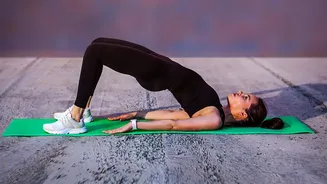
The glute bridge is excellent for 'waking up' and strengthening the gluteal muscles that become inactive from sitting. Lie on your back with your knees bent, feet flat on the floor about hip-width apart, and your arms by your sides with palms down. Press through your heels to lift your hips off the floor until your body forms a straight line from your shoulders to your knees. Squeeze your glutes at the top of the movement. Hold for a few seconds before slowly lowering your hips back to the floor. Aim for 10-15 repetitions.
Exercise 3: Seated Figure-Four Stretch
You can do this stretch right from your chair, making it perfect for a midday work break. While sitting upright, cross your right ankle over your left knee, creating a 'figure four' shape with your legs. Gently press down on your right knee to increase the stretch in your right glute and hip. To deepen the stretch, you can hinge forward at your hips while keeping your back straight. You should feel a stretch along the outside of your hip. Hold for 20-30 seconds and repeat on the other side.
The Power of Daily Consistency
The key to counteracting the effects of sitting isn't an intense, hour-long workout once a week. Instead, the solution lies in consistency. Incorporating these gentle exercises into your daily routine, even for just five to ten minutes, can make a significant difference. Regular movement helps improve blood flow, maintain joint mobility, and prevent the muscles from adapting to that shortened, seated position. Think of it as a small, daily investment in your long-term mobility and comfort. You can do these stretches in the morning to start your day, in the evening to unwind, or during short breaks from your desk.